
Samira Vishwas
Tezzbuzz|20-07-2026
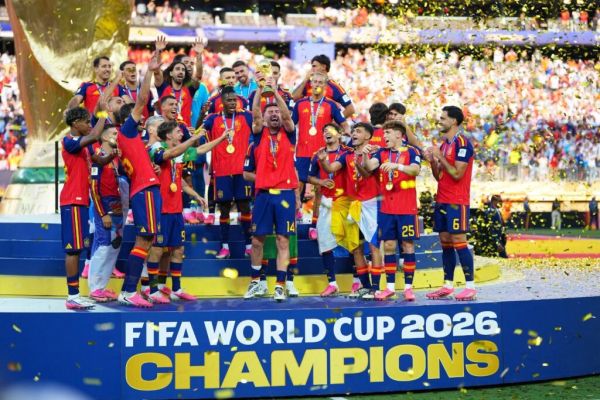
Spain spent decades as football’s great underachievers — a country synonymous with brilliant club football but strangely allergic to World Cup glory. They made their debut in the quadrennial contest in 1934, yet it took until 2010 for them to reach the final, sixty years after their only prior semi-final appearance. They won the title that year, beating continental rivals, the Netherlands, in the title clash in South Africa. On Sunday (July 19), they rewrote that script, dethroning reigning champions Argentina 1-0 in a one-sided final in New Jersey, USA.
Spain’s endless trophy-hunting
Spain’s second World Cup title confirms their status as a football superpower. As reigning European champions, they’ve echoed 2008-2010, when a Euro crown preceded World Cup glory by two years. Their record fourth Euro title in 2024 again arrived two years before this world crown. The Olympic title in 2024 means Spain has completed a historic treble with their latest feat. In 2012, Spain even won back-to-back Euros as world champions. It will be seen whether they repeat that brilliant history in 2028, when the championship takes place in Great Britain and Ireland.
Also read: Spain crowned FIFA World Cup 2026 champions
However, these are not the only laurels that Spanish football has earned on the football turf. Their women have also excelled, winning the World Cup in Australia and New Zealand in 2023. Sunday’s crown for Rodri’s men means the western European nation is now the world champions in both men’s and women’s formats. The men and women also won the Nations League thrice in total between 2023 and 2025, with the Eves bagging the title for two consecutive times.
Some of Spain’s top football crowns in recent years
Men’s World Cup 2026, 2010
Overall, in the last five years, Spain have won as many as 16 world and European titles, from under-17 to senior level.
‘Like a perfect storm’
Noted Spanish football pundit Guillem Balague told BBC Sport that what Spain have been doing in football is “dominance” and “it’s like the perfect storm”.
He said Spain is relentless.When Spain choked Argentina at the MetLife Stadium on Sunday, one could see a system taking on individual charisma, and it was the system that finally prevailed. As Brian Sciaretta wrote in a piece for Fox Sports, while La Roja have world-class names on their roster, it is their team which is the star, unlike Argentina’s Lionel Messi.
“Even with a player such as Lamine Yamal, who was recently a finalist for the Ballon d’Or as an 18-year-old, no single player is above the team or its system.
Instead, every player fills a role within that system and sticks to that role,” he wrote.Also read: World Cup final: How Spain outclassed Argentina with a tactical masterclass
Former Sweden international Zlatan Ibrahimovic echoed the same. A Fox Sports analyst, he said, when Spain shine, they do so collectively, despite having promising players such as Lamine Yamal in their ranks.
How Spain built its football system
How did Spain build such a system in place?
It did not happen overnight. The late Luis Aragonés coached the side from 2004-2008, before Vicente del Bosque took over through 2016 — years that saw Spain’s dream run, winning the Euro titles in 2008 and 2012, besides the 2010 World Cup. The team was also powered by a golden generation then: David Villa, Fernando Torres, Cesc Fàbregas, Andrés Iniesta, Gerard Piqué, and Carles Puyol.
That era also saw the birth of “tiki-taka”, the Spain-and-Barcelona-perfected style built on rapid short passing, triangular positioning for constant passing options, and relentless possession at high tempo. But like every age, Spain also faced a transition, and it was not easy to see it through.
La Fuente as coach
As the golden generation waned, La Roja faced adversity in World Cups between 2014 and 2022, when it failed to make even the quarterfinals. In came the Luis de la Fuente era, and Spain stormed the headlines again. After they crashed out of the 2022 World Cup in the Round of 16, Spain hired La Fuente, a step which was seen by many as bold and risky, but it paid off.
It was deemed risky since at that point in time, La Fuente hadn’t managed a big club, and he was given charge of a high-profile team which was looking to get back into prominence. It was not that the coach had successful stints as a coach even at club levels in Spain and Portugal. But with Spain’s youth teams, he found a way.
According to Balague, the move was risky, but La Fuente, a former player who spent a decade and a half looking after different clubs in succession, besides serving in junior and assistant coach positions and eventually Spain’s youth teams, knew the system and the style. Spanish football brains kept faith in an insider despite the recent debacles and it paid off.
Also read: Spain erupts into all-night carnival, millions flood streets singing ‘Viva Espana’ after WC win
The 65-year-old La Fuente, who now has a track record of 14 wins, zero losses and one draw in competitive games, knew many of the players he is handling now in the national team from his earlier days of coaching. The continuity of the coach and the emerging players has helped Spain’s cause. Former Spain midfielder Juan Mata emphasised that point while speaking to BBC Sport to say the current players are growing as a team and what the world is seeing as Team Spain now is not just one for the present, but also for the future”.
Oldest WC-winning manager’s handling of a young lot
What is remarkable about La Fuente is that, despite being the oldest manager ever to win a World Cup at 65, he has successfully taught Spain’s young players key aspects, such as respecting rivals, the process and valuing patience and composure. In fact, many other youth-level coaches also tried to put into place a system that rewards tactical brilliance, something La Fuente has done.
At his pre-final press conference, he said younger players had told him they’d already won everything at every level. His response was simple: the next match, in September, is what matters. The exuberance is unstoppable, but La Fuente has learnt to handle it well.
La Fuente has also not cared for the big names from the big Spanish clubs. When a controversy broke out after he did not pick a single Real Madrid player for the squad that headed to the World Cup, something quite unthinkable by Spanish football standards, the coach said the best players were picked for the tournament irrespective of the clubs’ names. The decision was vindicated by the team as Spain conceded just one goal in the entire tournament and won it despite a goalless draw against Cape Verde in their opening game.
The Spanish national team has remained unbeaten in 38 straight matches now — the longest run by any European or South American side in history.
Also read: From ‘also-rans’ to powerhouses: How Africa scripted historic World Cup in 2026
This insatiable hunger has spilt over to the clubs from the national level. Even though Pep Guardiola exited Manchester City after a decade of trophies, Spanish coaches now lead roughly a quarter of Premier League clubs entering 2026-27, BBC Sport reported.
Spain had already overtaken Argentina for the FIFA No. 1 ranking back in September 2025, after a gap of over a decade. The July 19 victory could only see the Spanish Armada turning into an unstoppable machine.
Spain’s promising young talents
Now, the players. The current Spain squad members — Yamal, Pedri, Rodri, and Nico Williams — give them a mix of proven veterans and teenage/young talent that most countries simply can’t match right now, besides the possession-heavy style that’s been their trademark for two decades.
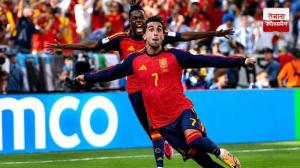
The winner that Ferran Torres pumped in against Argentina in the final was set up by a brilliant assist from Williams, both of whom had just come off the bench, adding freshness to the relentless attacks that Spain made, only to be deflected by an energetic Emiliano Martinez under the bars.
The range of awards that Spain players took home after the final — Rodri with the Golden Ball, Pau Cubarsi as the best young player and Unai Simon with the Golden Glove — simply proved the depth that the team’s squad carried in terms of individual brilliance, which all added up to a World Cup-winning combination.
The future looks brighter for Spain across formats. Yamal and Cubarsi, both 19, already have World Cup winners’ medals; national women’s player Vicky Lopez has three Champions League titles with Barcelona at the same age, while Salma Paralluelo has over 50 caps before turning 23. Yamal became the third-youngest World Cup finalist ever, behind only the legendary Pelé and Italy’s Giuseppe Bergomi, and with Cubarsi also starting, Spain became the first team to field two teenagers in a World Cup final.
Also read: Messi, Yamal and a World Cup final that feels like football’s passing of the torch
Former England goalkeeper Joe Hart told BBC Sport that Spain have got a way of playing that no one could get close to. The team saw just 10 shots targeted on goal against them in the entire tournament.
In the final, Spain finished with 1.94 expected goals compared to Argentina’s 0.20 — a thoroughly decisive victory even though it took extra time. Defensively, they were suffocating too: Spain conceded only one goal in the entire tournament, and Argentina managed zero shots on target in the final. Till the final, La Albiceleste scored at least two goals in each of the games they played. With Spain, the defending champions were clueless.
Former France international Thierry Henry told Fox Sports that Spain has indeed come a long way and has put in a system that would see them dominate for a long time to come.


Shubman Gill says Rohit Sharma has not spoken about retirement

'We are not winning anything' - Aakash Chopra cuts a sorry figure after India's ODI series defeat to England

WATCH: Virat Kohli Caught On Camera Pulling Funny Moves Behind Gautam Gambhir
Messi’s dream broken: Spain became world champion by defeating Argentina, Messi cried after losing