
Samira Vishwas
Tezzbuzz|12-07-2026
For generations of cricketers, Lord’s has represented the pinnacle of the sport. The Long Room, the Pavilion, the famous slope and the Honours Boards have all become part of cricket’s folklore. All cricketers talk about them and every player dreams of leaving a mark here.
Also read: Fans clamour for Sanju Samson after India’s another crushing loss
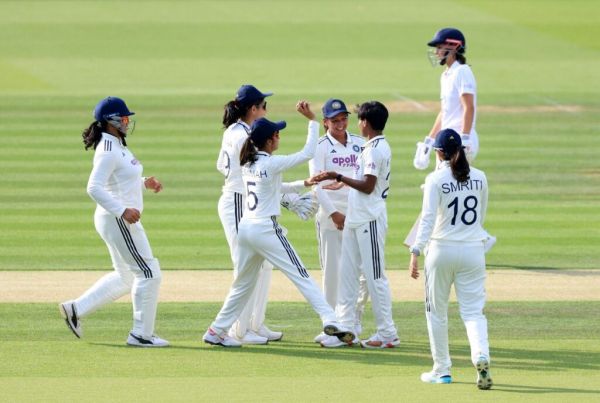
But this weekend, that dream takes on a new meaning. As India take on England in the first-ever women’s Test at Lord’s, it’s a truly historic moment at cricket’s most iconic ground, which has hosted men’s Test cricket since 1884 but has never staged a women’s Test.
It is a moment that has been decades in the making and one that speaks about how the sport itself has evolved.Another first for women’s cricket at Lord’s
The significance of the occasion goes far beyond four days of cricket. Exactly 50 years ago, in 1976, Rachael Heyhoe Flint led England Women onto the Main Ground at Lord’s for the first women’s international (60-over game) played at cricket’s legendary venue. At a time when women’s cricket struggled for recognition and opportunities, simply playing at Lord’s was a milestone.
Half a century later, more than 50 former England players returned to the ground to be honoured before the start of this historic Test. It was a fitting tribute to the pioneers who played the game when crowds were sparse, media attention was limited and professional contracts were almost non-existent.
The ceremony celebrated the past and the huge crowd present there reflected the future. More than 33,000 tickets had been sold before the match began, putting it among the best-attended women’s Tests in history and within touching distance of the world-record attendance for a women’s Test.
Those numbers would have been unimaginable even a decade ago, especially for a red-ball women’s fixture.Women’s cricket has come a long way
The journey from pioneers to packed stands has been long. Women’s cricket has spent decades fighting for visibility. Test matches became increasingly rare as administrators focused on shorter formats that promised quicker returns and wider audiences. Even as the women’s game steadily improved in quality, opportunities to play the longest format remained few and far between.
Also read: What is IPL connection in BBL’s Chennai move?
The last decade, however, has changed everything. Professional contracts have expanded, broadcasting has transformed the sport’s reach, and franchise cricket has reshaped the commercial landscape. The Women’s Premier League (WPL) has been central to that transformation in India. It has created stars, improved player earnings and introduced women’s cricket to millions of new viewers.
India’s rise has become one of the biggest drivers of the global growth in the women’s game. It’s no coincidence that one of the most significant moments in women’s Test cricket features India.
The country’s television market and passionate fan base have given women’s cricket a commercial boost unlike anything seen before. While the WPL has accelerated the white-ball revolution, it has also revived conversations around preserving and expanding women’s Test cricket.Captain Harmanpreet Kaur acknowledged the magnitude of the occasion ahead of the match, describing it as a special moment for the team and expressing hope that women would get to play many more Test matches in the years to come.
Coach Amol Muzumder recalls Ganguly feat at Lord’s 30 years ago
For India’s head coach Amol Muzumdar, the occasion is personal. Thirty years ago, he was sitting in the stands as a young domestic cricketer, watching another iconic Indian moment unfold. On the eve of the historic Test now underway, Muzumdar remarked that “it boggles my mind that this is just the first women’s Test match here at Lord’s”.
He recalled, “I came here in 1996. I watched the Test match where Sourav (Ganguly) got his first 100 and Rahul Dravid made his debut. I was playing up north in Yorkshire at that time and just came to watch the Test match. I saw a superlative 100 from Sourav. I was just sitting in the stands.”
Three decades later, he returns to the same ground not as a spectator, but as the celebrated coach of the Indian women’s team preparing for another landmark moment in the venue’s history.” The first-ever Test match at Lord’s will be special,” he said, while urging his players to move on from the disappointment of the recent T20 World Cup and embrace the opportunity ahead.
Hosts ecstatic over Lord’s game
England, too, recognises that this one-off Test carries significance beyond the result. Captain Nat Sciver-Brunt has spoken about the privilege of leading England in the first women’s Test at Lord’s and called it “an important step in the continuing growth of the women’s game.” Players on both sides understand that they are part of something truly special and much larger than just a bilateral series.
There is another layer of history that makes this occasion particularly meaningful. The Marylebone Cricket Club, the custodian of Lord’s, did not admit women as members until 1999. For much of its history, Lord’s symbolised traditions that excluded women from the highest spaces in the game. Now, as two women’s teams walk through the same Long Room that generations of the greatest names in men’s cricket have passed through, they carry big hopes for a sport that has steadily earned its place and risen in recognition.
Also read: Why new book on IPL rags-to-riches stories has at its core a flawed social assumption
The timing of this Test is equally significant. Women’s cricket has never enjoyed greater visibility. Yet one challenge remains in ensuring that Test cricket has a substantive future in the women’s calendar. That is why the attendance at Lord’s matters as much as the cricket itself. If a women’s Test can draw over 33,000 spectators at the Home of Cricket, it strengthens the case for more red-ball fixtures. It gives administrators confidence that the format has an audience. It gives sponsors another stage to support.
India Eves’ enviable Test record in England
As the two sides clash at the hallowed ground, Sciver-Brunt and her team are desperate to gain their first Test win over India in England. Harmanpreet’s side is looking to extend an unbeaten Test record in the country that has stood for over 40 years. The cricketing tussle promises to be an inspiring contest.
Lord’s has always been a place where cricket celebrates its history. Now, it is also celebrating how far the game has come and will offer us a glimpse of where women’s Test cricket is headed. As England and India battle it out, the last bastion of cricketing misogyny is all set to be breached at the ‘Home of Cricket’!
(The Federal seeks to present views and opinions from all sides of the spectrum. The information, ideas or opinions in the articles are of the author and do not necessarily reflect the views of The Federal.)





World Cup 2026: Spain beat Belgium 2-1; set up semi clash with France

Alarm Bells For Team India! BCCI To Review T20I Failures After England Tour

Shubman Gill Receives Prestigious Wimbledon Honour, Joins Sachin, Virat & Rohit In Elite Club

Abhishek’s big statement on Iyer’s captaincy, also told the secret of Suryavanshi’s fearless batting