
Samira Vishwas
Tezzbuzz|05-07-2026
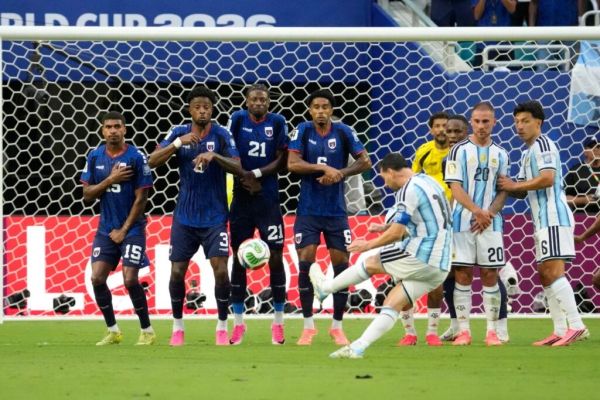
It’s been a few days since reigning world champions Argentina tamed an indefatigable Cape Verde 3-2 in the Round of 32 in the 2026 FIFA World Cup, but the match continues to occupy the football-crazy minds across the planet. Such was the contest that continued deep into the extra time when an own goal by the African debutants gave the nervous Albiceleste the ticket to the next round.
Also read: World Cup 2026: How Argentina coach Lionel Scaloni saw a 100-game evolution
The three-time champions eventually had the last laugh in the match that saw captain Lionel Messi topping the Golden Boot table once again by registering his seventh goal, and coach Lionel Scaloni overseeing for his 100th match as the national coach.
But the day also exposed several vulnerabilities in Argentina’s title defence, and they would make the side uncomfortable before the games ahead.Argentina have issues to address before Egypt clash
Now, with the Cape Verde game a thing of the past, the debate in the Argentina camp has shifted from what went wrong in that clash to what the coach should focus on before the next knock-out game, against Egypt, in Atlanta on Tuesday (July 7).
They are another African side which is yet to lose a game in this World Cup and stunned Australia in the Round of 32.The loudest demand is for tactical change. Several former Argentina players and football writers believe the current 4-4-2 has become predictable and ineffective against organised opponents. They want Scaloni to switch to a 5-3-2 system, with Leandro Paredes operating as the holding midfielder in front of the defence and Alexis Mac Allister pushed further forward to provide the creativity that was missing against Cape Verde.
Will players’ position be changed?
Changes in players are also being discussed. One proposal is to pair Marcos Senesi alongside Cristian Romero at centre back and move Lisandro Martinez to left back. Others want Exequiel Palacios or Giuliano Simeone to be given an opportunity on the right flank, an area where Nahuel Molina and Gonzalo Montiel have both struggled throughout the tournament.
Will Argentina show more trust in the next-generation players? Nico Paz remains one of the most exciting young talents in the squad. His natural tendency is to drift towards the right before cutting inside, movements that inevitably resemble Messi’s game.
That also creates a tactical problem because both players often occupy the same spaces.Also read: Why FIFA World Cup orbits around Argentina’s ‘North Star’ Messi
At the same time, Paz is a gifted free-roaming creator who could easily be deployed in a role similar to the one Angel Di Maria performed for years. Whether Scaloni has it in mind remains unknown.
Thiago Almada is another player at the centre of the debate. He naturally drifts towards the left and possesses outstanding football intelligence.
Some observers feel his development has become slightly too structured after playing under Diego Simeone at Atletico Madrid.Yet, Scaloni may still be reluctant to leave him out because of his intelligent leave that created Messi’s goal against Algeria in the first game. Against Cape Verde, Julian Alvarez was presented with a similar situation but failed to make the same decision, leaving Messi visibly frustrated.
Many believe this is also the moment to rotate the established midfield. Players such as Paz and Valentin Barco cannot develop without meaningful opportunities. That means difficult decisions involving Enzo Fernandez and Rodrigo De Paul, two players Scaloni has consistently trusted. There is a growing feeling that Enzo could benefit from a rest, while Giovani Lo Celso deserves an extended run in the starting eleven.
Playing with Messi, not for him
Underlying all these suggestions is one central argument. Argentina must return to being the team that played with Messi during the 2022 World Cup, not a team that simply plays for Messi, as happened under previous coaches.
The reason these demands have grown louder lies in what unfolded in Miami on Friday (July 3).
The debutants played exactly to their strengths. More importantly, Argentina allowed them to do so. A team of Argentina’s stature should have imposed itself from the outset and denied an inexperienced opponent the freedom to settle into its preferred rhythm. Instead, Cape Verde grew in confidence with every passing minute.
Also read: Mbappe scores 7th World Cup 2026 goal, pips Messi again in seesaw Golden Boot battle
The game unfolded almost exactly as expected. The Africans defended deep, stayed compact and attacked in transition. Argentina knew that would be the challenge. Scaloni’s plan was to dominate the midfield, control possession and stop those transitions before they began.
It never happened.
Whenever Cape Verde lost possession, they immediately reorganised into a disciplined 4-5-1 defensive block. Two compact lines denied Argentina any space between midfield and defence. Across 120 minutes, Argentina’s celebrated midfield failed to produce even a single through ball.
The problems extended to the flanks. Facundo Medina struggled on the left while Molina failed to provide width or penetration on the right. Montiel, introduced later, offered little improvement. Apart from corners delivered by Messi and De Paul, Argentina scarcely produced a dangerous cross into the penalty area.
Messi had too much to carry
Even with Lautaro Martinez and Alvarez playing together, the attack lacked sharpness. Both forwards drifted out of the game, leaving Messi to carry almost the entire creative burden.
That has become the defining feature of Scaloni’s Argentina. No matter how many goals Messi scores, he remains the team’s chief creator. Against Cape Verde, that creative supply simply disappeared.
Also read: No ordinary defeat: How early World Cup exits have ignited chaos, fury at home
Nothing illustrated Argentina’s midfield struggles better than the fact that all three goals originated through the central defenders rather than midfield playmakers. Messi repeatedly had to drift to both wings just to receive possession. Misplaced passes became increasingly common, and the trademark one-touch combinations that have defined the Scaloneta era repeatedly broke down.
Cape Verde’s extraordinary goalkeeper
If one player enhanced his reputation more than anyone else, it was Cape Verde’s 40-year-old goalkeeper Vozinha. He finished the match with eight saves and three perfectly timed runouts. Five of those saves denied Messi. His finest moment came in the 62nd minute when he anticipated the legend’s attempted nutmeg in a one-on-one situation and produced a superb block. Messi hardly misses such chances.
There was one major positive for Argentina, nevertheless. The central defensive partnership of Romero and Lisandro Martinez once again looked solid, suggesting that an area long considered a weakness has finally become a strength. The full-back positions, however, remain a serious concern, and judging by Scaloni’s post-match comments, significant changes against Egypt now appear increasingly likely.



ENG vs IND 2026: 'History has been created' - Internet celebrates Vaibhav Sooryavanshi's India debut
Former cricketers urge caution as Vaibhav Sooryavanshi’s India debut speculation grows
WATCH: Gautam Gambhir Talks To Sanju Samson As Vaibhav Sooryavanshi Takes His Spot

How To Book CPL 2026 Tickets