
Sandy Verma
Tezzbuzz|31-05-2026
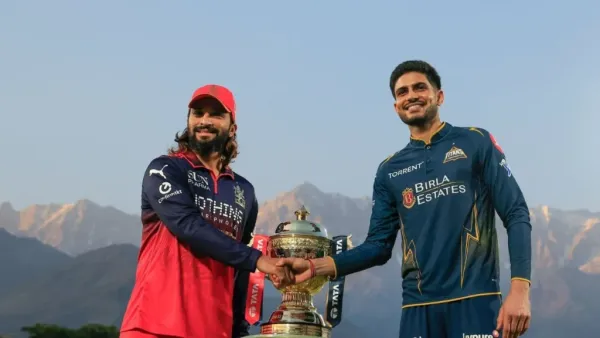
On paper, tonight’s IPL 2026 final in Ahmedabad is simple enough: Royal Challengers Bengaluru vs Gujarat Titans, one team chasing a historic title defence, the other trying to bring another trophy back to Gujarat. But finals are never just finals in Indian cricket. They become auditions, arguments, future projections, selection debates and occasionally, national leadership seminars disguised as a cricket match.
That is why this final feels bigger than the one between RCB and GT.
It is also about Rajat Patidar and Shubman Gilltwo very different captains who have spent the season challenging what people thought they knew about them.Shubman Gill arrives as the obvious national project. He is young, polished, already trusted in bigger leadership conversations, and built like the kind of player Indian cricket loves to invest in over the long term.
Rajat Patidar arrives from the other lane entirely: older, quieter, less marketed, less obvious, but currently leading the most mature version of RCB anyone has seen. One is the natural heir.
The other is the awkward question selectors may not have expected to answer.With Suryakumar Yadav now 35, India’s T20I captaincy future cannot be parked forever. The selectors will not decide that future from one IPL final alone. That would be silly. But one IPL final can change the temperature of a debate. It can turn a candidate into a frontrunner or a name into a problem that cannot be ignored.
Shubman Gill is the succession plan India already understands
Shubman Gill’s case is the cleanest because Indian cricket has already built so much around him.
He has the game, the image, the age profile and the multi-format weight. At 26, he is already treated like a long-term captaincy candidate in T20Is, and if India want one leadership voice across formats, Gill is the easiest name to put on the whiteboard.But T20 has been the format where the question marks have lived. Across 15 T20Is in 2025, Gill made only 291 runs at an average of 24.25, and his omission from India’s recent T20 World Cup squad was explained through combinations, though everyone could see the larger issue. T20 batting had moved quickly. Strike rates were rising. Six-hitting had become currency.
Shubman Gill’s elegance, for all its beauty, had started to look a little too polite for the new chaos.That is what makes his IPL 2026 season so important. He has not answered the criticism by pretending to be someone else. He has answered it by upgrading the old version. His 722-run campaign has been built on timing, placement, cleaner powerplay intent and the belief that there is still more than one way to dominate a T20 game.
Qualifier 2 was the best proof. Gujarat were chasing 215, the kind of target that usually makes teams think only in sixes. Gill made 104 off 53 balls, with 15 fours and only three sixes, and stitched together a 167-run opening stand with Sai Sudharsan.
It was not blind hitting. It was controlled at high speed. He found gaps, ran hard, reduced dot balls and made a huge chase feel organised.That matters for India because Shubman Gill’s captaincy case is not just about runs. It is about the method. His leadership style is visible through his batting: composed, frontline-led, slightly controlled, almost corporate in its neatness. He sets the tone by being the best batsman on the side. He doesn’t need to look frantic to be aggressive.
If Shubman Gill lifts the trophy tonight, the story becomes very convenient for the BCCI. A young Indian captain, already important across formats, producing a 700-plus run IPL season, winning a title with GT, and proving that his T20 game has modernized without losing its base. That is the kind of resume that selectors like because it looks both safe and ambitious.
A title would not just help Shubman Gill return to India’s T20I side. It could make his long-term captaincy claim very difficult to ignore.
Rajat Patidar is the disruptor nobody planned for.
Rajat Patidar’s case is more complicated, which makes it more interesting. He is not the obvious national captaincy candidate. He does not talk like one, market himself like one, or appear desperate to become one.
In fact, on the eve of the final, when asked about India selection and even about leading India one day, he gave answers that almost sounded allergic to hype. Rajat Patidar said he was not looking forward to India selection and did not visualize himself as India’s T20 captain.
That, somehow, makes the case more powerful.
Rajat Patidar has led RCB in a way that feels almost anti-RCB. Calm, structured, unemotional, practical. This franchise has historically carried noise like luggage. Expectations, star power, fan pressure, Virat Kohli’s presence, title drought trauma, then finally the defending champion tag. Taking over that kind of team is not easy. Taking over that kind of team and making it look stable is a genuine achievement.
His batting has also broken old labels. For a long time, Rajat Patidar was seen mainly as an elite spin-hitter. Teams thought the plan was simple: keep spin away, test him with pace and bounce, force him into uncomfortable zones. Gujarat arrived in Qualifier 1 with exactly that kind of attack: Kagiso Rabada and Mohammed Siraj threatening with the new ball, Prasidh Krishna and Jason Holder operating with hard lengths and bounce later.
Rajat Patidar still made 93 not out off 33 balls.
That innings was loud on the scorecard, but smarter than just hitting. Five fours, nine sixes, and one of the shots of the season: a back-foot six over cover off Rabada. This was not a batter surviving a weakness. This was a batter removing the weakness from the conversation. His strike rate against pace has surged this season, and his post-powerplay scoring has been among the most destructive ever for an IPL season.
That is where Rajat Patidar becomes dangerous as a leadership candidate. He is not just captain calm. He is tactical batting violence without emotional noise. He has made RCB balanced, mature and ruthless while sharing the dressing room with Kohli, which is a leadership test in itself. It takes a certain personality to command respect without trying to out-shout the biggest presence in the room.
If RCB win tonight, Rajat Patidar will not only become a back-to-back IPL-winning captain. He would also break the old curse around defending champions and put himself in elite company with names like MS Dhoni and Rohit Sharma as skippers who have successfully defended an IPL title. That is not a small domestic footnote. That is a serious leadership credential.
India may not immediately hand him the T20I captaincy. But if a man leads RCB to consecutive titles, scores at a frightening tempo, stays calm under playoff pressure and keeps winning the hardest T20 league in the world, selectors cannot simply say, ‘Nice IPL, now please stand outside.’
IPL 2026 final tests two different ideas of leadership
The fascinating thing about Shubman Gill and Rajat Patidar is that they represent two different routes into the same conversation.
Shubman Gill is the planned route. The player in Indian cricket already knows how to sell and structure around. He is young, visible, technically elegant, and already part of the national leadership, leading India in ODIs and Tests. A title would feel like the final stamp on a file that has been moving through the system for years.
Rajat Patidar is the proof route. He has forced the discussion through performance, not projection. He was not designed as India’s next T20I captain in the public imagination. He has simply kept winning, kept striking at a ridiculous rate, kept making RCB look unusually sane, and now stands one match away from doing something historic.
One is the chosen heir. The other is the working captain, who may make the chosen heir debate uncomfortable.
There is also a battle of batting philosophies here. Shubman Gill has spent the season arguing that timing, placement, running and gap-finding still matter in a world obsessed with sixes. His Qualifier 2 hundred was almost a defense of classical T20 batting updated for modern demands. Rajat Patidar has gone the other way: remove the labels, attack pace and spin, and turn the middle overs into a demolition site.
Both methods have worked. Both have reached the final. That should matter to India.
The national T20 side is moving into a phase where leadership cannot be only about reputation. It has to be about tactical clarity, tempo management and dressing-room control. Shubman Gill offers continuity and long-term structure. Rajat Patidar offers proof of immediate T20 leadership under the most pressurized domestic conditions.
Will the IPL trophy decide India’s next T20I captain?
Not officially. India will not announce a T20I captain just because someone lifts a trophy tonight. Selection is never that simple, even when fans want it to be. There are seniority questions, squad balance questions, format availability questions and dressing-room dynamics to consider.
But finals create memory. If Shubman Gill wins, it strengthens the cleanest succession story: the young all-format leader also conquers the IPL as captain and answers doubts about his T20 game. If Rajat Patidar wins, it creates a different pressure: how do you ignore a captain who has defended an IPL title with RCB, scored heavily, struck fast and looked calmer than almost everyone around him?
That is why Ahmedabad matters. Not because one match decides everything, but because one match can make an argument feel inevitable.
Shubman Gill has the structure of destiny around him. Rajat Patidar has the stubbornness of evidence.
Tonight, one of them will lift the IPL trophy. And when he does, the celebration will belong to his franchise first. But somewhere behind the scenes, in selection meetings and future planning documents, the question will sit quietly.
Is India’s next T20I captain holding that trophy?



Asian Games 2026: Indian Government Steps In; Suryakumar Yadav Dropped

IPL 2026: 'I see it as an advantage' Shubman Gill on playing IPL final in Ahmedabad

[WATCH] 'Give him the freedom' - Sachin Tendulkar's massive statement on Vaibhav Sooryavanshi's future as Test batter

Curry Leaf Plant Growth: Add this thing to curry leaf plant, new leaves will grow fast. gardening-hacks-curry-leaf-plant-care-use-kitchen-ingredient-for-bushy-growth