
CricketnMore
newspoint|13-04-2026
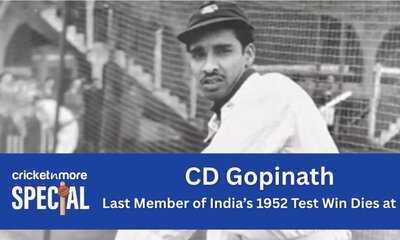
Indian cricket mourns the loss of CD Gopinath, who passed away at the age of 96, marking the end of a remarkable era in the sport. He was the last surviving member of Indias historic first-ever Test-winning team in 1952.
Gopinath never had any intention of becoming a cricketer and was an accidental cricketer. He started playing cricket at 17. lsquo;No one believes me when I tell them that I started that late. I had played hockey, football and tennis before, but never cricket, he used to say.
He was the oldest living Indian Test cricketer since the death of Dattajirao Gaekwad of Baroda (13 February 2024).
Chingleput Doraikannu Gopinath, an elegant right-hander, played eight Tests from 1951-52 to 1959-60 with moderate success (242 runs in 12 innings at 22.00 with one 50) but was a champion batsman for Madras in the Ranji Trophy in the fifties (2349 runs at an average of 51+ with six hundreds and an HS of 234), although he started with a pair in his first Ranji Trophy game against Mysore in the 1949-50 season.One year later, he made his India debut in the fifth unofficial Test against the Commonwealth XI at Kanpur and scored 66* in a losing cause. In December 1951, Gopinath made his Test debut against England at Bombay and what a start he made: unbeaten 50 in the first innings and in the second innings he rescued India from 77 for six, which included an eighth wicket partnership of 71 runs with SW Sohoni.
Gopinath was out for the top score of 42 and India saved the match.In the final Test of the series, at Madras, Gopinath scored 35 and added 93 runs for the seventh wicket with Polly Umrigar and India ultimately registered a historic win. Gopinath took the Test-winning catch to dismiss Brian Statham off Vinoo Mankad. The best part was that till last he recalled the great moments of the historic Test win.
Similarly, when Madras registered its maiden Ranji Trophy triumph in 1954-55, he was in the side.He remembered,lsquo;In 1952, when we won that Test match in Madras, it was a great surprise even to us. Hence, the victory was so much more exciting and sweet. Probably for the first time, we believed that we could beat a side thats stronger than us. It ushered in a new way of thinking.
He got scattered chances in the crowded India middle order and played his last Test against Australia at Calcutta in 1959-60 where his 39 were the top score in the first innings but ended with a duck.
After his playing days, he remained in close touch with the game. He was on the selection committee for nine straight terms from 1968-69 to 1976-77, the last five as its chairman. He was manager of the Indian team to England, in 1979.
He penned his memoirs lsquo;Beyond Cricket, A Life in Many Worlds with the help of ace cricketer V Ramayana.
A very strange and lesser known story is associated with his birth in 1930. The day he was born in Madras (now Chennai), the British police opened fire on a procession of people protesting against the British Raj in the city and shot two locals to death.
This caused a riot-like situation and a curfew was imposed, with the orders to lsquo;shoot to kill the violators. Taking a cue from the situation, the doctor wrote the name of the newborn as lsquo;Baby Gun and, surprisingly, Gopinath remained keenly involved with guns and shooting in his later life.Another lesser known fact : where is that historic ball, caught by the youngest member of the Indian team, Gopinath (in front of the MCC pavilion of the MA Chidambaram Stadium) to get Brian Statham out, to win the Test? Gopinath kept this ball as a souvenir, got it signed by his teammates, and it is still there in his home in Connor. However, after more than 70 years, almost all the signatures have worn off.
He was one of the last few people who met the legendary West Indies cricketer Frank Worrell before his death. Worrell came to Madras in 1967 and Gopinath invited him home for dinner. There, Worrell disclosed that, for the last week or ten days, he had been feeling strangely, lsquo;Im feeling unnerved and low. Gopinath had advised him to consult a doctor. Within a week, Worrell died of leukaemia, undiagnosed.
A very famous story in Indian cricket is of 1952 when, during the England tour, the only non-Hindi-speaking cricketer in the side was advised to learn Hindi, so that the captain, Vijay Hazare, could communicate in Hindi, making it difficult for the English batsmen to understand the planning. This cricketer was none other than Gopinath.
Also Read: Live Cricket ScoreNow, after Gopinaths death, 95-year-old Chandrakant Patankar, who played one Test against New Zealand at Eden Gardens in 1956 is India#39;s oldest living Test cricketer.

KKR And Ajinkya Rahane Shredded For Horrendous Decision: 'Makes Absolutely No Sense'

IPL 2026: 'It's Always Winning And Learning, Never Losing,' Says Hardik After MI's Third Straight Defeat
'The 'lack of wickets' narrative is…' - R Ashwin shuts down Jasprit Bumrah's critics after four wicketless outings
IPL 2026: 'Wanted To Keep The Batsman Guessing,' Says Krunal On His Strategy In RCB's Win Over MI