
Sandy Verma
Tezzbuzz|07-04-2026
When Sunrisers Hyderabad released Bhuvneshwar Kumar ahead of the 2025 mega auction the cricket world largely nodded along as if the decision made obvious sense. He was 35 and his pace had dropped.
Younger generation of Indian seamers had seemingly moved past Bhuvneshwar Kumar and a franchise that had built its identity around his bowling for eleven seasons decided that identity needed refreshing.
What happened next is the kind of story that makes you question every confident assessment you have ever made about a cricketer being finished.
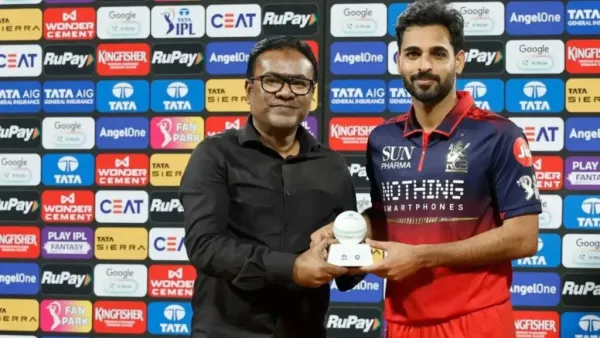
RCB picked him up and he helped them win their first ever IPL title in 2025 taking 17 wickets across 14 matches.Then on April 5, 2026, at the M Chinnaswamy Stadium against Chennai Super Kings, Bhuvneshwar Kumar dismissed Ayush Mhatre with a hard length delivery that cramped the batter and lobbed a catch to mid-off and became the first fast bowler in the history of the IPL to reach 200 wickets. Bhuvneshwar Kumar finished with 3 for 41 and RCB won by 43 runs and went to the top of the table.
Sweeping someone under the rug has a way of producing that kind of result when the person underneath still has something left to prove.
The SRH release was not just a selection decision, it was a statement that turned out to be completely wrong
To understand what makes the 200 wicket milestone feel the way it does you have to appreciate what the SRH release actually communicated to the broader cricket world. This was not a franchise quietly letting go of a fringe player at the end of a contract.
This was Sunrisers Hyderabad, the club Bhuvneshwar Kumar had served for eleven seasons, the club for whom he remains the all-time leading wicket-taker with 157 wickets, the club no other player has even represented in 100 matches let alone taken 100 wickets for, telling the market that they did not believe he had enough left to justify a roster spot.
When a franchise makes that call about their own legend the message travels fast and it tends to stick. Most franchises at the 2025 auction would have looked at the SRH decision as validation for their own hesitation.
RCB did not hesitate. RCB paid 10.75 crore for Bhuvneshwar Kumar and a significant section of the commentary called it an expensive indulgence in nostalgia.
What it actually was is one of the shrewder pieces of recruitment the IPL has seen in recent years.Bhuvneshwar Kumar at 35 bowling hard lengths and cutters with a 7.69 career economy rate is not the Bhuvneshwar of 2016 swinging it both ways at 137 kph. Bhuvneshwar Kumar is a different and in some respects more complete bowling proposition. a man who has replaced raw assets with something harder to manufacture who is understanding of exactly what a T20 innings needs at any given moment.
He is the only bowler in IPL history to win the Purple Cap in back to back seasons. He has the most powerplay wickets any bowler has ever taken in the competition. And he was released because people thought he was done.
The numbers across sixteen seasons are not the story of a career that faded, they are the story of one that evolved
Lazy version of the Bhuvneshwar Kumar narrative is that he had a peak between 2014 and 2017 that was exceptional and everything since has been decline managed carefully enough to extend a career past its natural end.
That version falls apart when you actually look at what the numbers say across different phases of his IPL career. Between 2014 and 2017 he took 87 wickets in 59 matches at an economy of 7.2, a rate that only three bowlers across that period improved and all three of them were spinners.
Back to back Purple Caps in 2016 and 2017 remain unique in IPL history. His 81 powerplay wickets are the most any bowler has ever taken in that phase in the competition’s history. His 93 deaths over wickets place him second only to Dwayne Bravo.
These are not the statistics of a bowler who got lucky at his peak and then survived on reputation. They are the statistics of a bowler who has been genuinely effective across multiple formats and multiple phases of T20 innings across sixteen seasons of the highest level domestic T20 competition on earth.
The 200 wicket milestone is significant not because of the round number but because of what the journey to it required, sustained excellence across a timeframe that has seen multiple generations of fast bowlers arrive, peak and fade while Bhuvneshwar was still taking wickets in the powerplay and at the death.
Bhuvneshwar Kumar – 202 wickets in 16 seasons
Dwayne Bravo – 183 wickets in 15 seasons
jasprit bumrah – 183 wickets in 12 seasons
Lasith Malinga – 170 wickets in 12 seasons
RCB vs CSK: What the Bhuvneshwar Kumar’s 200th wicket for at Chinnaswamy actually means
Milestone wicket itself was entirely in keeping with the version of Bhuvneshwar Kumar that exists in 2026 rather than the version that existed in 2016. No late swing. No outswinger angling away from the left hander.
A hard length delivery directed into the body of Ayush Mhatre that cramped the batter and produced a simple catch to mid-off. It was a wicket taken through thought rather than pace and that distinction matters because it is precisely the evolution that SRH decided was insufficient and that RCB decided was worth 10.75 crore.
With Josh Hazlewood unavailable at the start of this season Bhuvneshwar Kumar has stepped into the role of RCB’s attack leader without any visible adjustment period and the figures of 3 for 41 for RCB against Chennai to help defend 250 and win by 43 runs are the result of someone who has been in high pressure situations so many times that the pressure itself has stopped being a variable.
At 36 the question of how much longer Bhuvneshwar Kumar continues is legitimate but it is also probably the wrong question to be asking right now.
More interesting question is how many of the people who nodded along when SRH released Bhuvneshwar Kumar are willing to admit that the release was wrong and that RCB read the situation correctly when almost everyone else did not. The 200 wickets are one answer. The position at the top of the IPL table is another.


This decision of Rahane made many former great players of India ‘strongly’ angry.
Key Stats & Approaching Player Milestones

IPL 2026: How Sameer Rizvi repaid Delhi Capitals' faith in him?
Sai Su delivers batting masterclass but Titans fall short in last-ball thriller