

Sandy Verma
Tezzbuzz|01-04-2026
New Delhi. Amidst the digital revolution in India, now the bugle has been sounded for the Maha Census which will change the picture and destiny of the country. The Central Government is going to start the first phase of Census-2026 from 1st April 2026. This time the census will not only be hi-tech, but it will also give a new glimpse of social changes. The most surprising change is regarding live-in relationships. According to the new rules, if a couple has been living in a live-in relationship for a long time and considers it a permanent relationship, then they will be kept in the category of ‘married’ in the census records.
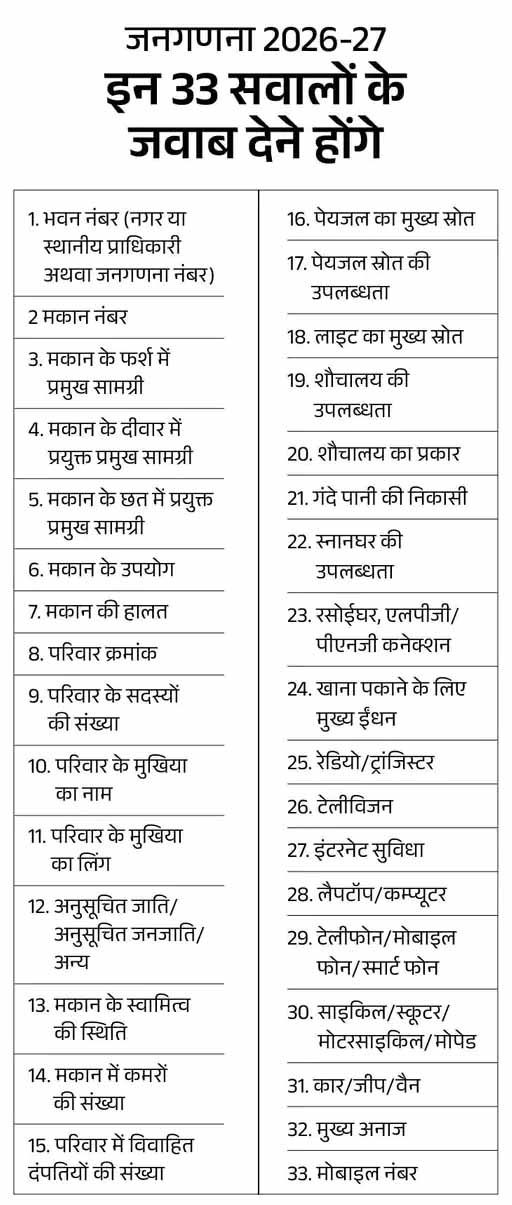
List of 33 questions ready, you can also fill the information yourself
The first phase of the census has been named ‘House Listing and Housing Census’. In this you will be asked a total of 33 questions, which will be to the condition and basic facilities of your house. The special thing is that this time the government has given a big relief to the public by giving the option of ‘self enumeration’. That is, you can enter your information yourself on the census portal sitting at home. FAQ (Frequently Asked Questions) facility has also been provided on the portal to help the people so that no mistakes are made while filling the form.
Caste census will be held for the first time after independence
According to the Union Home Ministry (MHA), this mega census campaign will continue till September 30. Every state and union territory of the country has been given 30 days to complete the work. This will be the first time since 1931 that caste data will also be collected through digital medium. This census will be completely paperless, for which about 30 lakh employees will use Android and iOS apps. This process will be made transparent through real time data transfer.
Full attention to privacy: Employees will never ask these 3 things
Your safety and privacy during the census is of paramount importance. The government has clarified that the workers coming to the field will not ask you for the following information:
-
Details of your month’s earnings or bank balance.
-
Any compulsory pressure to show Aadhaar, PAN or any other identity card.
-
Bank account number or any OTP received on your mobile.
Every house will become ‘Digi Dot’ on the map, know its 5 unique benefits
This time, unmatched use of technology will be seen in the census. Geo-tagging of every house will be done, due to which the house will appear as a ‘digi dot’ on the map. Its main advantages are as follows:
-
Accurate Disaster Management: In a situation like flood or earthquake, it will be easy to find out how many people are trapped in which house.
-
Precise delimitation: Now there will be no mistake in the division of localities in determining election constituencies.
-
Smart Urban Planning: On the basis of data, it will be decided where a school should be built and where a hospital should be built.
-
Keep an eye on migration: In the next 10 years it will be known how many people have left villages and settled in cities.
-
Control on fake voter cards: Matching of Aadhaar and geo-tagging will eliminate the problem of duplication of names in the voter list.






IPL 2026: 'We Didn't Score Enough In The Last Five Overs,' Says Gill After GT Loss Against PBKS

PBKS vs GT: Punjab Kings started with a thrilling win, Connolly dashed Gujarat’s hopes

ECB introduces replacement players for injuries, illness, and life events in County cricket

IPL 2026: 'I Varied My Pace And Line To Put Them Under Pressure,' Says Chahal After PBKS Halt GT At 162/6