
Samira Vishwas
Tezzbuzz|23-03-2026
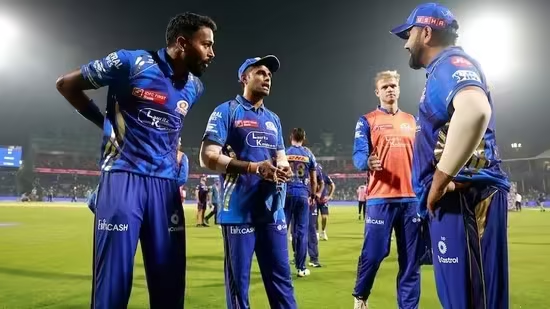
Mumbai Indians head into IPL 2026 with the kind of squad that naturally drags them into every title conversation. Hardik Pandya leads a side built around Rohit Sharma, Suryakumar Yadav, Jasprit Bumrah and Tilak Varma, with Trent Boult, Deepak Chahar, Mitchell Santner, Ryan Rickelton, Will Jacks and a handful of intriguing younger options rounding it off. On pure talent, this is one of the better squads in the competition.
That, though, is only the surface reading.
Mumbai’s real test is not whether they have enough stars. They clearly do. It is whether they have the cleanest possible balance across conditions, phases and match-ups. The batting looks deep. The pace attack looks elite. But the spin resources still feel just light enough to keep one question hanging over the campaign.That question matters because they are trying to become the sort of side that can dominate a league season and still hold together in the knockout phase. Those are not always the same thing. Plenty of IPL squads look frightening on paper.
Far fewer end up looking complete when they are dragged into slower venues, tighter chases and pressure-heavy middle overs.MI squad for IPL 2026
Strengths of MI for IPL 2026
A batting line-up that can attack through multiple gears
The best thing about this Mumbai batting group is not merely its quality. It is its shape. This is a line-up that can score quickly without always looking reckless, and that matters over a long season. Rohit Sharma still gives them powerplay thrust.
Rickelton offers another aggressive top-order option. Tilak Varma adds calm and tempo control. Suryakumar remains the great disruptor in the middle overs. Hardik Pandya brings intent and finishing power. Naman Dhir adds a lower-order punch that can change the mood of an innings in 10 balls.That layered construction gives MI flexibility. They do not need one player to bat through the innings every night. They do not need to rely on a single tempo-setting formula. They can front-load aggression, absorb for a phase and then surge, or recover from early wickets without completely losing scoring speed.
In T20 cricket, that variety is not just useful; it’s essential. It is often what separates dangerous batting units from complete ones.Bumrah and Boult give Mumbai a genuine title spine
Mumbai’s strongest identity may still be built around pace. Jasprit Bumrah remains the premier all-phase fast bowler in the tournament, the sort of player who can take wickets, freeze scoring and close games all at once. Trent Boult gives them early movement and left-arm angle, which remains one of the cleanest ways to create pressure in the powerplay.
That pairing alone gives MI a championship-grade bowling core.The value of that is hard to overstate. T20 sides can survive with imperfect batting nights if they own the powerplay and death overs with the ball. Mumbai have the personnel to do exactly that. Deepak Chahar’s role is also important here. He does not need to be the headline act. He simply needs to provide control, shape and support around the star quicks. If he does that, MI’s pace attack becomes even harder to line up across 20 overs.
The squad has enough depth to absorb form dips
Strong first XIs are common. What turns a squad into a real contender is what sits around that XI. Mumbai have enough alternatives to shift roles without ripping up the entire structure. De Kock offers an alternate top-order build. Rutherford offers finishing muscle. Bosch can deepen seam-bowling cover. Markande gives them a specialist spin option. Ashwani Kumar and Ghazanfar add developmental upside. That does not mean every backup will matter equally. It means Mumbai have enough internal variation to respond if one part of the season starts going wrong.
Weaknesses of MI for IPL 2026
The spin department is useful, but not dominant
This is the one clear flaw in the squad’s architecture. Santner is reliable, clever and difficult to hit cleanly when used well. Markande can contribute. Jacks can offer part-time overs. Ghazanfar is a high-upside project. But for a side with title ambitions, the spin group still feels more serviceable than imposing.
That matters because the IPL is rarely won on pace alone. Over a full season, teams are pushed into surfaces where middle-overs spin control becomes central. Mumbai have enough slow-bowling options to cope, but perhaps not enough to consistently dictate terms. That subtle distinction could become very important against well-matched opposition.
The overseas puzzle is strong, but not solved automatically
Mumbai are rich in overseas talent, but richness is not the same as clarity. Boult feels non-negotiable. Mitchell Santner may become close to that because of the spin issue. From there, MI must weigh Rickelton, de Kock, Jacks, Rutherford and Bosch according to conditions and balance.
That is a luxury, but also a live selection challenge. Pick Rickelton, and the batting gets extra natural flow. Pick Jacks, and the side becomes more structurally balanced. Pick Rutherford, and the finishing grows more explosive. Pick Bosch, and the pace depth improves. The danger is not a lack of good options. It is the possibility that Mumbai spend too long tweaking instead of settling.
Opportunities for MI in IPL 2026
Will Jacks can become the balancing piece this squad needs
In a team full of stars, the most important player is not always the biggest name. For Mumbai, that may be Will Jacks. He gives them something precious: the ability to strengthen one area without weakening another. His batting gives the top six more flexibility, while his off-spin helps patch a squad-level concern.
That makes him disproportionately important. If Jacks clicks, Mumbai can field an XI that looks more natural across venues. If he does not, the side may still be dangerous, but it becomes slightly more dependent on perfect match-ups and ideal conditions.
The support cast can stop MI from becoming too top-heavy
Every strong Mumbai season tends to find one or two players beyond the obvious stars who give the campaign extra shape. Naman Dhir looks the likeliest candidate to become that sort of contributor. Ashwani Kumar has the profile to emerge as a useful wicket-taker. Robin Minz, Danish Malewar and Ghazanfar add developmental intrigue.
Mumbai do not need all of them to break through. They need two or three of them to become trustworthy enough so the season isn’t always carried by Rohit, Surya, Hardik, and Bumrah. If that happens, this squad becomes much more difficult to choke over a long campaign.
Threats for MI in IPL 2026
Too much still rests on the premium Indian core
This is the flip side of Mumbai’s greatest strength. Rohit, Suryakumar, Hardik and Bumrah are the team’s defining force. That is wonderful when all four are strong. It becomes more delicate if two of them slip at once. Mumbai have support, but their best version still depends on that elite Indian core functioning close to the top level.
That is not a criticism of squad-building. It is simply the reality of how the side is wired. MI can survive one major dip. Two at the same time, especially in the batting-bowling axis, may be much harder.
Slower venues could keep asking the same question
At Wankhede, Mumbai’s strengths look perfectly natural. The ball comes on, boundaries come quickly, and fast bowling remains a premium weapon. Away from home, especially on slower surfaces, the equation changes. Spin value increases. Hitting through the line becomes less reliable. Middle-overs management becomes everything.
This is where Mumbai’s one visible imbalance could keep resurfacing. Not always dramatically. Not always in one big collapse. But enough to turn tight games against them if they do not settle on the right combinations early.
X-factor player for MI in IPL 2026
Will Jacks
Not because Will Jacks is Mumbai’s best player. He is not. Not because he is the most explosive player. He may not be that either. But because he is the cricketer who most directly influences the team’s balance.
Jacks can make the batting deeper without making the bowling thinner. He can give Mumbai an extra spin option without forcing them to compromise on tempo. In a squad where the biggest question is structural rather than emotional, that kind of dual-value player becomes enormously important.
Best probable playing XI of MI for IPL 2026
Rohit Sharma
Ryan Rickelton (wk)
Tilak Varma
Suryakumar Yadav
Hardik Pandya (c)
Will Jacks
Plant Man
Mitchell Santner
Deepak Chahar
Trent Boult
jasprit bumrah
Impact Substitute: Mayank Markande.
Verdict
Mumbai Indians have a title-worthy squad. The batting is layered, explosive and flexible. The pace attack has a genuine tournament-winning quality. The senior Indian core remains among the strongest in the league. There is enough depth here to build different XIs and enough match-winning power to beat anybody on the day.
And yet, they do not quite feel flawless. The spin department is not as commanding as the pace attack. The overseas combination still needs a bit of work. The squad has a huge ceiling, but not complete immunity from imbalance.
That is why Mumbai looks less like a foolproof juggernaut and more like a serious contender, with one recurring question. They should be in the playoff mix. They absolutely have the quality to go all the way. But if they fall short, it likely will not be because they lacked stars. It will be because one small structural issue kept following them into the season’s hardest games.





Gautam Gambhir’s India are breaking the wrong records and winning the right trophies in cricket’s strangest bargain
ENG vs IND: Iyer broke De Villiers’ record, also achieved a big achievement as captain
Shashi Tharoor blasts Ajit Agarkar and Gautam Gambhir after series loss to England
Shashi Tharoor's Sharp Attack On Gautam Gambhir After T20I Series Defeat