

CricketnMore
newspoint|12-03-2026
In an exclusive interview with IANS, Tandon reflected on the current state of Indian squash, the pressures and perks of playing at home, and what success looks like for him at this stage of his career. With a unique perspective bridging past and future generations of Indian squash, Tandon’s insights highlight not only his personal journey but also the growing ecosystem of support that is propelling Indian squash to new heights.
With just over a week to go before the Indian Open, Tandon is in his taper phase, where training intensity decreases to allow peak performance during the tournament.
“Preparations have been good so far. I have another week and a half before the event, so I'm kind of in my taper phase. But yeah, it's been a good few weeks. It's been good to be home. Normally, I'm competing in different parts of the world, so my training camps are also in those countries. But the few times we get to play in India, we get to be home and be pampered. So it's been good so far,” Tandon told IANS.
The home environment allows Tandon to focus on recovery, minimise travel stress, and fine-tune his game with his full support team by his side. The Asian Games is Tandon’s main target this year, offering both prestige and a chance to qualify for the Olympics.
“It is the most important event of the year. Firstly, it is the Asian Games that garners its own respect. But apart from that, obviously, it's the qualification for the Olympics, which is an addition for squash because we have not been in the Olympics before. So not only for me, for every Asian player in the top four, top eight in Asia, we are looking at that as an entry into the Olympics. So it's definitely the most ambitious, not ambitious, but the most important goal for the year.
"And obviously, my team is aware of it. I have a team; when I talk about my plans and my training plans, I'm just a follower. The orders come to me from my coaching team. So we are aware of it as a team. We have made it a point that the goal would be to peak at the Asian Games and everything else is designed around that.”
Every tournament, including the Indian Open, is part of a carefully mapped plan to ensure Tandon is at his best when it matters most.
Tandon believes that he belongs to the generation that bridges past legends and rising stars. "Squash has been…every phase we have had strong players. I'm kind of stuck in between. The previous phase was obviously a sort of Ghoshal, Harinder, Sandhu phase, but those guys are a good five, six years older than I am. And then I'm the one in between that is part, you know, I didn't see their complete journey, but I was towards the end of their journey and towards the start of this journey.
"But having said that, it's a very unfair way to look at it to compare generations. In cricket, when you look at it, when you look at Virat Kohli, you say Sachin Tendulkar has played a big role in making Virat Kohli. And Virat Kohli is playing a big role in making maybe a Shubman Gill or someone else. So, you know, as a sport, we work as one team.
"If there were no Saurav Ghosal, there probably would not be a pipeline of players below that. If there were no Joshna or Deepika, there probably would not be an Anahat today. So you've got to give them credit. Credit is due when it is, right, in these situations. And having said that, we are at a good... As a country today, we are at a very strong phase. You know, we have four men in the world's top 50, which is not the norm for Indian squash.
"Anahat is doing extremely well, Joshna is still around. And you've got to also be aware of the support systems today, right? Like what Saurav and Harinder Sandhu, or Joshna and Deepika, didn't receive back in the day, we are receiving today. So fair enough, we should be better, and we should outperform the previous generations. Because if we don't, then it's not on us. It's showing the support system that the country is not working well enough for us to outperform. So, Indian squash is in a good place.
“Corporate firms are backing squash, which is a big step forward for us as squash players. Squash making the Olympics, we have like tops, the government scheme, we have been included in that, which again is a big boost. So I'm very hopeful that, in the years to come, the current generation and future generations will outperform what our ancestors left behind for us. I don't think ancestors would be a bad term. I'm not counting Saurav as an ancestor (laughs). I'm talking about like the generations of squash players.”
Tandon believes that Indian squash today has stronger infrastructure, funding, and visibility than ever before, which is a vital factor in nurturing future champions.
The Indian Open offers the rare opportunity to compete in front of a home crowd. For Tandon, this is both comforting and challenging.
“It's extremely important. Two reasons, obviously, as I mentioned before, you have like the most number of players in the top 50 of the world. More Indian players in the top 50 in the world today than we have ever had before, which means you need to also step up the level of competition and bring international competitions of this magnitude to the country.
“Gives us home advantage, gives us advantage of the conditions, gives us a month of being home with our families and competing in our own country in front of the people who have supported us. So also means fewer flights, the one, two times a year we get to play at home, which is a big thing, with the Asian Games coming about, it's not only about competing, it's also about being rested and being injury-free. As you mentioned, at the 2022 Asian Games, I had a hamstring issue and couldn't make it, right? So similarly, like having events at home obviously gives me the sense that my team is home, I have physios at my service at home, which is hard to do when you're on the road.”
He added that international tournaments at home inspire the next generation, showing young players the level of competition they can aspire to.
“Beyond me and beyond the top players in the country, in terms of creating a culture for the upcoming generations, for the eight-year, 10-year-olds, who are going to be watching and looking at squash at the international level, it's just creating a level where they would see beyond what we used to when we were kids.”
Playing at home brings expectations, but the 33-year-old sees it as a test of resilience.
“Everything that's positive also has a negative to it, right? And playing at home, obviously, you're comfortable. The climate favours you a little bit, but at the same time, there's a lot of pressure. You're around people who want you to do really well. There's a lot of expectation, and you've got to deal with that as well, which is important as an athlete. You know, you can't run away from pressure.
“You need to deal with and breathe through these situations. And it just makes you tougher as a squash player, right? Every competition, the way we look at it as Indians, we are very result-oriented, you know? Like when we talk to someone about the board exams, the first thing we ask is, how much did you get, right? And it's the same thing in our sport, you know? We only look at the result, and we ask, like, "Oh, are you going to win or lose?"
“But what you also have to look at is, like, what's making you better as a sports person? What's making you better as an individual? And going through these situations definitely adds value, you know? And you might not see the benefit of it in this tournament, but that mental toughness might come through in the Asian games, you know? And so overall, it's good to put yourself through these situations.”
“You need to deal with and breathe through these situations. And it just makes you tougher as a squash player, right? Every competition, the way we look at it as Indians, we are very result-oriented, you know? Like when we talk to someone about the board exams, the first thing we ask is, how much did you get, right? And it's the same thing in our sport, you know? We only look at the result, and we ask, like, "Oh, are you going to win or lose?"
Also Read: Live Cricket Score“It's the biggest thing for world squash as a whole, you know? Like, we've tried a bunch of times and haven't made it. And then finally making it to the Olympics for LA 2028 is probably the biggest achievement my sport has had as a whole. And Indian squash being part of world squash as a by-product, I being a squash player.
Article Source: IANS





What Does Sanskrit Line On Indian Premier League Trophy Mean?
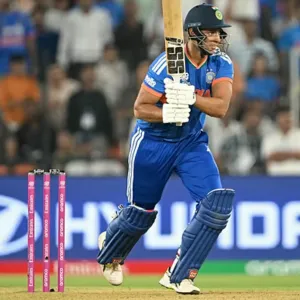
Why Shivam Dube took a train instead of a flight after T20 World Cup success
Structural changes being planned in Tamil Nadu’s Ranji Trophy preparation, says TNCA secretary

IPL 2026 Full Schedule Announced: RCB to face SRH in opening fixture; full list of fixtures, timings, venues