
Sandy Verma
Tezzbuzz|06-03-2026
Honestly, Sanju Samson’s time has come. It has been a long time coming.
Debuting in 2015, he played one match against Zimbabwe, scored 19 and then disappeared from the international scene for four years. No one would have blamed him if he had given up. Yet here we are in 2026 and Sanju Samson is the name everyone is discussing. This isn’t due to luck. It’s because he quietly and stubbornly refused to stop.
For a player whose career has been a series of stops and starts, four different batting positions in his first 14 matches, five years between his first and second international games, the uncertainty was nothing new. What changed this time was how he handled it.
Before the West Indies game
Before the West Indies game, Sanju Samson sat on the bench for two matches. Most players in that position start to panic, overthink, or scroll through negative commentary about why they shouldn’t be on the team. Not Sanju Samson. As he said to Star Sports after the West Indies game, he turned off his phone, avoided social media, and trusted himself. It was that simple. “I didn’t want to make too many changes because I knew I had performed well playing my natural game. So I backed myself, turned off my phone, stayed away from social media, and listened to my inner voice.”
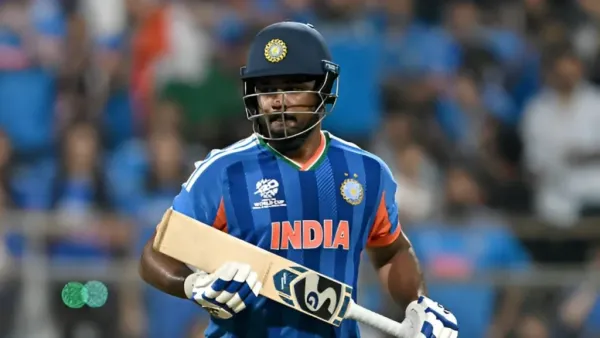
Sanju Samson went out and scored 97 off 50 balls, hitting twelve fours and four sixes. Eighty-eight of his runs came in boundaries alone. He single-handedly led India to the target while wickets fell around him. Against the spinners, he scored 37 off 17 balls. His strike rate was the highest among Indian batsmen who faced more than five balls that evening. When the last run was made, he sank to his knees and prayed. It was simply gratitude.
Sanju Samson steps up again for India against England
Three evenings later, tonight, Sanju Samson stepped onto the field at Wankhede in Mumbai for a World Cup semi-final against England. After winning the toss, England opted to bat first. Fifty thousand fans filled the stands. Sanju, once the player who couldn’t get a game, was now the first name on the team sheet. After Abhishek Sharma fell early, Sanju took charge from the first ball. He quickly scored 41 off just 20 balls in the powerplay, helping India reach 67 for 1 before the field had even spread. He brought up his fifty in 26 balls, marking his second consecutive half-century at Wankhede in this tournament.
But the defining moment came against Jofra Archer, one of the fastest bowlers in the world, charging in on a lively pitch. Sanju Samson hit 15 runs off a single over from Archer, including an upper-cut for six that defied physics and a straight drive that left Archer speechless. He fell for 89 off 42, caught at deep cover off Will Jacks, just eleven runs short of a century. The Wankhede crowd rose as one to give him a standing ovation. At the time of his dismissal, India were 160 for 3 in the 14th over, scoring at over 11 runs per over. A total over 220 was already a certainty. England were finished, which proved to be true as India ended at 253/7.
Ten years in the making
So, what has really changed?
Back in 2015, Sanju Samson often looked like a player trying to prove he belonged at the highest level. In 2026, he walks in and bats with the confidence of someone who finally knows his strengths and weaknesses.
The difference isn’t talent; that was always apparent to anyone who watched him bat. The change came during his quieter years. After a tough series against New Zealand this year, Sanju Samson took a 10-day break to reset technically. He addressed a restlessness at the crease, a habit of moving too early, by establishing a stiller, wider base, keeping his head perfectly over the ball at the moment of impact.
This stillness is what allowed him to face Archer’s 145kph deliveries without being rushed. He had time, real, eerie time. He also corrected a flaw that analysts had pointed out for years: a fixed-speed bat swing that led to mistimed pulls. Now, his hands only accelerate when the ball is in his zone. He isn’t muscling it; he’s timing it. Even his mis-hits are clearing the ropes. Then there’s the aspect that doesn’t show up in any biomechanical report. He stopped planning his shots in advance.
The old Sanju decided what he would play before the ball left the hand, making him predictable and exploitable. Now he waits and lets the ball come into his hitting zone. You saw this against Adil Rashid in the semi-final: back in the crease, reading the length, using his wrists to find the gap. No guessing, just seeing and hitting.
After the West Indies game, he talked about watching Virat Kohli and Rohit Sharma closely over the years, learning how the best players finish matches. “I have not been playing, but looking from the dugout, learning from the greats like Virat Kohli, from Rohit Sharma, like all the greats. I think it’s very important to observe and learn and see what they were doing.” He watched, understood and learned.
The T20 World Cup 2024 win still stings. He was in the squad for Barbados but was the only player in the entire 15-man group who did not play a single ball. Think about what that means: he trained with his teammates every day and traveled halfway across the world, only to watch them lift the trophy from the dugout.
That’s a unique kind of pain without a name. He didn’t let it defeat him. He returned and scored three T20I centuries in a single calendar year, against Bangladesh and South Africa, becoming the first Indian to achieve this. The label of ‘unlucky’ began to fade away.
Slowly at first, then all at once. Ten years. Four different batting positions. Countless drops and recalls. A World Cup medal won without stepping on the field. And now, back-to-back match-defining innings in the knockout stages of the T20 World Cup 2026. For those watching from Kerala or wherever Indian cricket fans gathered that night, these two innings felt like settling a debt. It was one of those special moments in sport, a moment where the wait, patience, and hard work in empty nets finally shine brightly.
Sometimes, those who waited the longest hit the hardest when their moment arrives. Sanju Samson is living proof of that.




Finn Allen’s 33-Ball Ton: Complete list of records smashed in SA vs NZ semifinal

IPL 2026 CSK Head Coach, Support Staff
Switched off phone, social media

'Pretty Up There': Finn Allen on Record-Breaking Century That Sent New Zealand into Final