
Samira Vishwas
Tezzbuzz|19-02-2026
The year was 2014. Mumbai, led by Suryakumar Yadav, entered the tournament as 40-time champions. They may not have possessed the star power of earlier eras, but with Wasim Jaffer, Aditya Tare, Abhishek Nayar, Dhawal Kulkarni, and the young duo of Shreyas Iyer and Shardul Thakur in their ranks, they still packed a formidable punch. So when Mumbai hosted J&K in a Group A clash at the Wankhede Stadium, the result appeared a foregone conclusion on paper. But cricket matches aren’t decided on paper. On the field, the heavyweights from Mumbai were edged out by a side whose best achievement until then had been a quarterfinal appearance the previous season.
Cut to 2026, and boy, have J&K come a long way. A maiden Ranji Trophy final, with one win separating them from the title. Cricket, you absolute beauty.
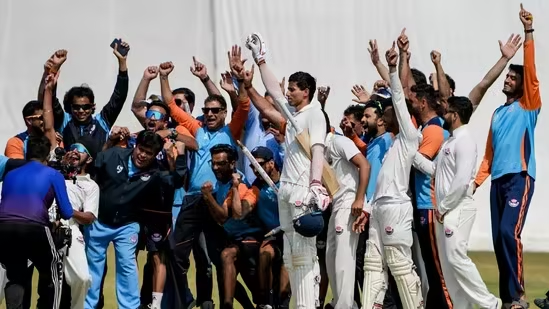
For J&K, the last 12 years have flown by. Kids have grown into boys, boys into men, and men into the grey zone of life. However, Parvez Rasool’s love for J&K remains constant. The first player to represent India from the state, Rasool, is no longer an active professional cricketer, but his heart beats for this team louder than ever. When Vanshaj Sharma sealed the win with a six off India pacer Mukesh Kumar in Kalyani, Bengal, his teammates erupted in celebration as if there were no tomorrow. Nearly 2,000 kilometres away in Anantnag, Parvez Rasool’s heart swelled with joy.
Nabi-Sunil fuelled J&K create history by reaching their first-ever Ranji Trophy final
“Definitely, it’s a great moment for us. Reaching the Ranji Trophy final was always our dream, and for a team like ours, it means even more. When you talk about smaller states that aren’t traditionally known for cricket, opportunities and belief don’t come easily.
“It’s been a gradual process. In smaller states, you don’t have many people motivating you or showing you the way. But once we started winning three or four matches in a season and then qualified for the quarterfinals the following year, things began to change. Selectors started noticing us. People began asking who was performing well. That never used to happen earlier in J&K cricket,” Rasool tells The Read.
With wins came belief. The fitness levels improved, training standards rose, and J&K began to understand what it takes to compete with the best. The mindset shifted from just turning up to winning games. When there’s performance, there’s recognition. Rasool himself got selected for the Board President’s XI and earlier for India A – the first player from J&K to achieve that. Later, when his name came up in the IPL, people took notice. Same for Umran Malik and Abdul Samad. The kids back home got inspired. They realised that if they performed well and helped the team win, they could move ahead too.
“In 2017, we qualified for the quarterfinals again. Last year, too, we reached the quarters. But this year is special. Reaching the Ranji Trophy final is a proud moment for all of us. It was our dream. We defeated a strong team to get here, and we thank God for that. Now we hope and pray we can go one step further and win the final. That would be something truly historic for Jammu & Kashmir,” added Rasool.
2011 marked the winds of change in J&K cricket, triggered by the arrival of Bishan Singh Bedi, whose influence extended far beyond tactics and technique. Until then, J&K’s record since its Ranji debut in 1957 had been modest, with only a handful of wins across decades. The team often approached the tournament as participants rather than genuine contenders. Bedi fundamentally altered that mindset, instilling the belief that they were not there merely to make up the numbers but to compete with conviction.
“For me personally, he was like a guru. A big part of my success is because of what I learned from him. He taught us one simple thing: don’t just participate – compete. Earlier, we would play five matches and lose most of them. Winning one game felt like an achievement. But he told us, ‘Go out there to compete. Losing is not a problem, but never go into a game with a losing mindset. Believe in your skills.’
“When I look back now, I truly feel grateful for what Bedi sir instilled in us. May God bless his soul. The biggest lesson he gave us was simple but powerful: compete, believe, and back yourself.”
Surprisingly, though, in infrastructure, there hasn’t been much improvement. Back in 1957, J&K had two proper grounds – in Jammu and Srinagar. Shockingly enough, even today, almost 70 years later, there’s no addition. From the cricket association’s point of view, there hasn’t been any major development in that area. Despite that, this group of players – Abdul Samad, Shubham Khajuria, Umar Nazir, Shubham Pundir and others – have been playing together for the last five or six years.
J&K need more grounds, better infrastructure
“I just hope that infrastructure improves in the coming years. Ideally, every district should have at least one proper ground where children can train, practise and play quality matches. It’s important to understand that the cricket association and the government operate separately. The Jammu & Kashmir Cricket Association still has only two grounds, despite 20 districts in the region. There isn’t a single ground owned by the association in any other district. That said, the J&K Sports Council, which comes under the government, has done commendable work. In districts like Anantnag and Baramulla, turf wickets and other facilities have been developed. Indoor halls and practice grounds are being built across districts, giving young players better opportunities.
“Hopefully, in the future, infrastructure will continue to improve. When children have proper facilities and see their state team reach the finals, they begin to believe they can succeed too. That belief is what truly changes the system.”
Besides Rasool, Irfan Pathan is another name synonymous with J&K cricket. After wrapping up his career as a full-time professional cricketer, Pathan transitioned into a mentoring role, making his debut with J&K during the 2018-19 season. Under him, the team reached consecutive quarterfinals. His role transcended his title; from handling administrative work to serving as a team strategist and coach, Pathan’s shoulder was there for everyone to lean on. No wonder watching his bunch of youngsters grow into a group of potential champions fills his chest with pride.
“Absolutely wonderful rise. I had no doubt that these guys would achieve something great. I am incredibly proud of how they played the semi-final. They are beating the big teams, Mumbai, Delhi, and Rajasthan. They actually stopped Madhya Pradesh as well. The whole way, the entire team is coming together, which is very special. So yes, the rise of Jammu and Kashmir cricket is very heartening to see,” Pathan tells The Read.
“During my tenure, I always used to say, ‘Ye jo ab hum beej bo rahe hai zameen pe 2018-19 main, aane wale waqt me isme pedh bhi aayega, usme phal bhi lagenge aur log iski chhaon mein bhi baithenge. Log iske phal bhi khaayenge. (During my tenure, I would often say that we were only sowing the seeds. I was confident that, in time, those seeds would grow into trees. They would bear fruit, people would sit in their shade, and they would enjoy the rewards.) Today, when I look at the progress, I have no doubt that those words are coming true. It’s truly wonderful to witness this growth and see the results of that hard work.”
While belief and structure laid the foundation for J&K’s rise, the evolution of the team itself has been just as crucial. For years, the side relied heavily on its bowling attack to stay competitive, often lacking the batting depth to close out big matches. But that balance has shifted this season, turning them from a resilient unit into a complete one.
“I think now that the batting has improved a lot. See, the bowling was always there. The bowling has continued to improve, especially with guys like Auqib Nabi performing consistently. Getting the big wickets in tough times, but the batting has started to come together. Guys like Abdul Samad have made a big impact. The batting has come together nicely, and that is the one major reason behind Jammu and Kashmir’s upward curve,” says Pathan.





Accused of gaining 10 kg weight, now hit 10 fours and sixes, Preity Zinta got excited on Prabhsimran’s answer

Accused of gaining 10 kg weight, now hit 10 fours and sixes, Preity Zinta got excited on Prabhsimran’s answer
Accused of gaining 10 kg weight, now hit 10 fours and sixes, Preity Zinta got excited on Prabhsimran’s answer

Accused of gaining 10 kg weight, now hit 10 fours and sixes, Preity Zinta got excited on Prabhsimran’s answer