


CricTracker
newspoint|08-02-2026
The ICC Men’s T20 World Cup 2026 commenced on February 7, with matches spread across India and Sri Lanka. With flat pitches, shorter boundaries, and heavy dew expected at several venues, the tournament is set up to reward teams that can sustain aggressive batting across all 20 overs rather than rely on brief bursts of power.
In modern T20 cricket, depth, role clarity, and adaptability matter more than individual star power alone. Teams that can attack in phases, absorb pressure, and accelerate without structural collapse are best placed to dominate.
Here are three best batting line ups for this T20 World Cup India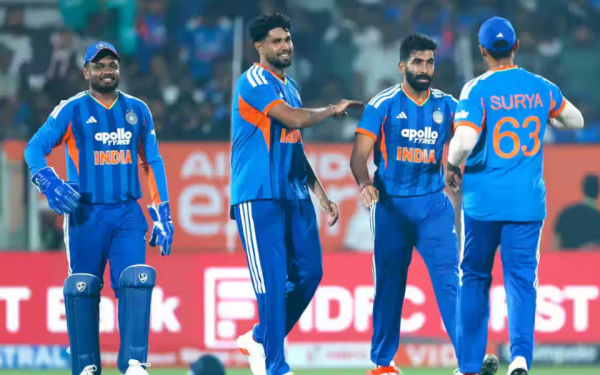 Team India.
(Photo Source: BCCI)
Team India.
(Photo Source: BCCI)
India entered the 2026 T20 World Cup as defending champions with a batting unit built on depth and precise role definition. At the top, the presence of the No.1-ranked T20I batter Abhishek Sharma has transformed India’s powerplay approach. Since his debut, he has emerged as leading six-hitter in the format, allowing them to attack early without destabilising the innings.
The middle order remains equally effective, with Tilak Varma providing control against spin and Suryakumar Yadav’s 360-degree game disrupting bowling plans, and Hardik Pandya, Shivam Dube, and Rinku Singh taking charge at the death.
With Axar Patel capable of batting at No.8, India possess rare depth that supports sustained aggression throughout the innings.India have crossed 200 runs 20 times in T20s since 2023, operating at a run rate of 9.69, and strike a six every 10.99 balls, the best figures among teams in the tournament. Recent chases of 153 in 10 overs and 208 in 15 overs against New Zealand highlight how quickly they can shift gears.
Australia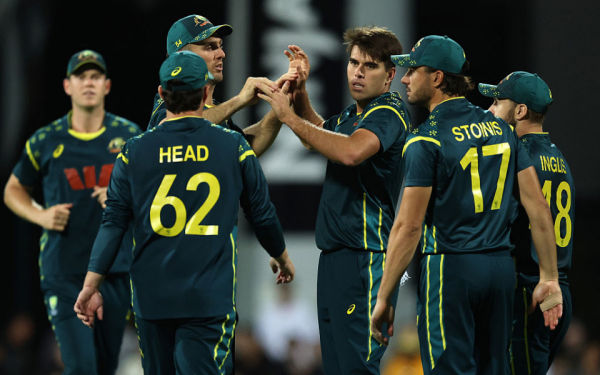 Australia Team. (Photo Source: Robert Cianflone/Getty Images)
Australia may not always look the most glamorous on paper, but in tournament conditions their batting unit is consistently ruthless. Built around power and big-match temperament, their lineup is designed to absorb pressure and strike decisively.
Travis Head and Mitchell Marsh form one of the most destructive opening pairs in T20 cricket, capable of dominating both pace and spin. Years of exposure to IPL, have strengthened Australia’s ability to score on slower subcontinental surfaces an area that once limited them in Asia.
Their middle and lower order provides relentless firepower. Josh Inglis and Cameron Green offer clean hitting through the middle overs, while Glenn Maxwell, Marcus Stoinis, and Tim David ensure sustained acceleration at the death. Several Australian batters, particularly Maxwell and Inglis, possess unorthodox scoring options that allow them to manipulate fields on flatter pitches.
Statistically, Australia rank second only to India in six-hitting efficiency, striking a six every 11.72 balls.
With injuries affecting their bowling unit, batting will shoulder greater responsibility a role Australia are well equipped for, having lost only one T20I series since the 2024 World Cup. 3. England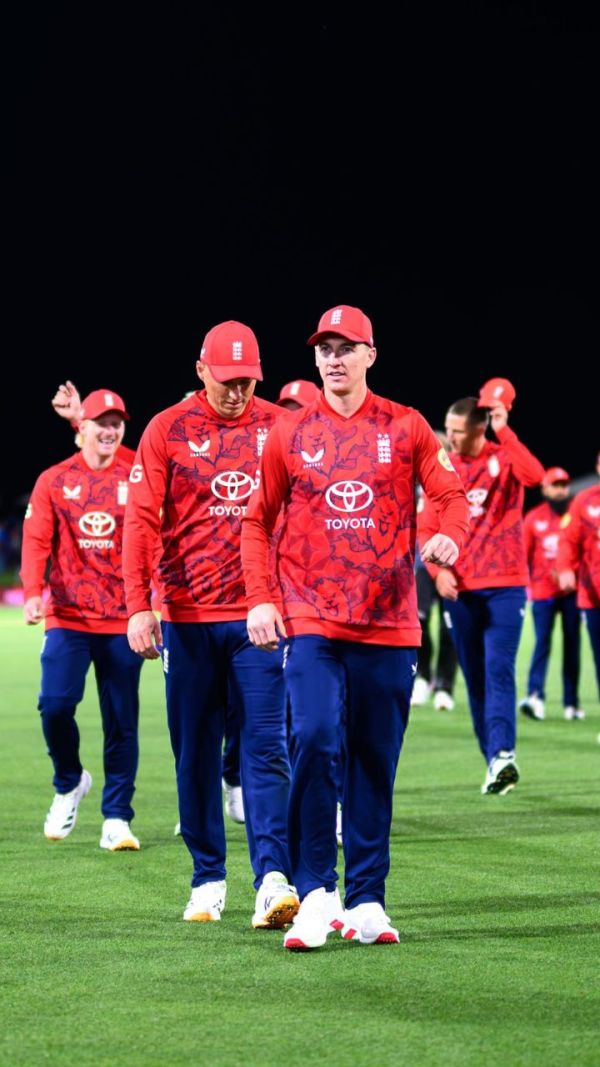 England team
England remain one of the trendsetters of modern T20 batting, built around deep attacking intent rather than reliance on a fixed top order. They arrive at the 2026 World Cup after a dominant whitewash of Sri Lanka in Sri Lanka.
With Jos Buttler at the top and Phil Salt no.2 T20I batter in the top three, England have players capable of absorbing pressure early and switching instantly into attack. Buttler’s all-round batting game and experience in India, combined with Phil Salt’s familiarity with these conditions, provide a clear edge. England’s middle order adds further depth and flexibility, as Harry Brook and Jacob Bethell have proven their credentials as high-impact T20 batters, while Sam Curran offers balance as both a stabilizer and late-overs hitter.
Their batting ceiling was evident when they posted 304 against South Africa the highest T20I total by a Full Member against another Full Member. Since October 2023, England rank second only to India in the number of 200-plus scores and strike a six every 14.81 balls. With group-stage matches scheduled at the Wankhede Stadium and Eden Gardens stadium in Kolkata, conditions are well suited to England’s free-flowing batting approach.






T20 WC: England Unveil Playing XI For Campaign Opener Against Nepal

IND vs USA: Ishan Kishan or Sanju Samson? Team India has decided, this star will open

England Reveal Their Cards Early, Name Playing XI For T20 World Cup Opener vs Nepal
T20 World Cup 2026 IND vs USA: India’s Predicted Playing XI For Opening Clash