
Samira Vishwas
Tezzbuzz|29-01-2026
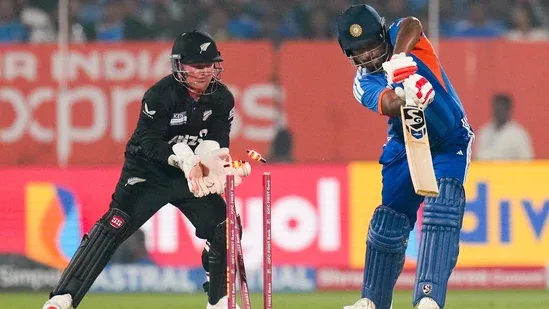
Sanju Samson was drafted into the playing XI as an aggressive opener in place of Shubman Gill who was struggling to play the role in the chances he got. But since then Samson has flopped to really prove his worth and there has been a lot of discussion around his spot in the team. So, does India really have a Sanju Samson problem?
The fact is India have a “Sanju Samson spotlight” problem, a selection narrative so loud it turns every short failure into a referendum, even when the same run of games is full of similar mini-failures from others.
That matters because India are trying to build a T20 side that wins phases, not debates. When one player’s lean patch becomes a daily courtroom drama while others are protected by role-based excuses, the team loses something more valuable than performances: clarity.
In the New Zealand T20I series, Samson’s first four scores read 10,6,0, and 24 – four innings, four low scores, no defining knock yet. That’s a lean sequence, not a verdict. But it is enough to ignite talk because Samson is rarely judged like a normal batter. He is judged like an argument.
Look around the same series and you will find repeat blanks that don’t attract the same heat. Abhishek Sharma has produced two golden ducks in four matches. Two. Yet the conversation doesn’t stick because his other two innings were match-warping assaults – 84 off 35 and 68 off 20. When your job description is break the powerplay, volatility is treated as a part of the deal. A duck becomes the price of chasing a disruptive start.
Ishan Kishan is another example of how one defining innings can cover the quiet ones. His series includes an 8 off 5 and a 28 off 13 – and then the slate cleaner: 76 off 32 in a 209 chase. In modern T20 selection, impact often beats trend and class. One unforgettable knock buys patience; two modest ones are filed under fine.
Even the captain’s recent form tells you how the narratives work. Suryakumar Yadav came into this stretch with a lean phase – his first fifty in 24 innings came during the second T20I vs New Zealand, and analysis of that run shows his returns against pace had dipped sharply. But within the series he has already banked 82 off 37 and 57 off 26. Because of his return to form and his reputation as a T20 player, there has not been much discussion about his spot in the team even during his lean phase.
Why does Samson’s every small failure become the headline trial?
In India’s current setup, the wicket-keeper batter spot is a high-drama, low-seat economy. The conversation is framed as a binary – Sanju Samson versus Ishan Kishan – with the subtext that when Tilak Varma returns, there may only be room for one. That transforms Samson’s innings from contribution to audition. When you are measured against a rival rather than a role, you are always under scrutiny.
There is also a Samson paradox: his ceiling is so freakish it raises the minimum people demand from him. He has already shown he can be elite in T20s. Once you have done that, you are not judged as the guy who can play a smart 35 when the chase is shaky. You are judged as the guy who should win you a game every time he survives the initial phase. Expectations don’t follow logic, they follow memory.
The saner way to frame it is simple. If you are going to judge Samson, judge him the way you judge everyone else: by role, over a meaningful sample, with the same tolerance for volatility you grant other high-impact batters.
If India accept Abhishek’s two matches because the upside can win matches in ten overs, they should also accept that Samson won’t deliver a defining innings every night. If they praise Kishan for one explosive chase defining knock, they should also admit quiet games exist for everyone. And if they understood SKY’s slump as a phase rather than a loss of worth, they should extend the same basic fairness to Samson.





Sophie Molineux Named Australian Women's All-format Captain

Jasprit Bumrah: Why is Jasprit Bumrah getting beaten continuously? The performance of the last 12 months speaks volumes
'Learned How To Be A Little Smarter': Shivam Dube Reflects On His Standout IND vs NZ T20 Knock
Australia Name New All-Format Captain: Sophie Molineux Replaces Alyssa Healy