Sandy Verma
Tezzbuzz|23-01-2026
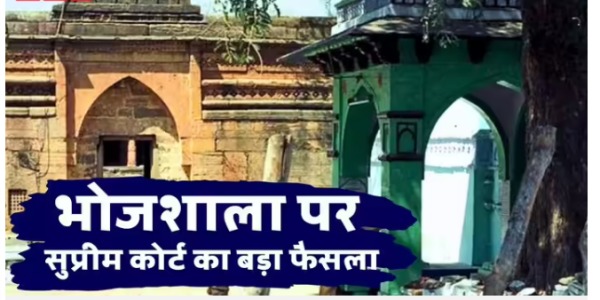
New Delhi: The Supreme Court has given an important and balanced decision on the long-running dispute regarding the historical Bhojshala located in Dhar, Madhya Pradesh. Amidst the tension arising out of Basant Panchami and Friday falling on the same day, the apex court has set timings for both puja and namaz, respecting the faith of both the communities. After this decision, now the Hindu community will be able to offer prayers on Basant Panchami and the Muslim community will be able to offer Friday prayers.
Scheduled time for worship and namaz
The Supreme Court has clarified in its order that on January 23, on the day of Basant Panchami, the Hindu community will be allowed to worship from morning to 12 noon. After this, people of the Muslim community will be able to offer Friday prayers between 1 pm and 3 pm. From 4 pm onwards, the Hindu community will be allowed to worship again, and there will be no restrictions on this. This arrangement will ensure that both the communities can follow their respective religious traditions peacefully.
Why did the matter reach the Supreme Court?
The matter reached the Supreme Court when the Hindu Front for Justice filed a petition demanding permission to perform Akhand Saraswati Puja throughout the day on Basant Panchami. It was argued in the petition that since Basant Panchami and Friday are the same day, the Hindu community should be given the right to worship throughout the day and Namaz should be banned. However, the Supreme Court decided to divide the time as an amicable solution, keeping in mind the rights of both the parties.
Strict security arrangements
There has been tension in Bhojshala on such occasions before, especially in 2006, 2013 and 2016 when Basant Panchami fell on Friday. Keeping this in mind, this time the administration has made unprecedented security arrangements. About 8 thousand policemen have been deployed in Dhar district. The Bhojshala complex and an area of 300 meters around it has been declared a ‘no-fly zone’. The crowd will be monitored with the help of drones, CCTV and Artificial Intelligence, so that any untoward incident can be prevented and both the communities can carry out their religious activities peacefully.




Century after century… Sarfaraz Khan once again replied to the selectors, roared with his bat in Ranji Trophy.
'Siddhesh Is The Crisis Man, I'm Proud He's Leading Mumbai', Says Father Rohit Sharma's Childhood Coach Dinesh Lad

T20 World Cup 2026: Sports adviser Asif Nazrul to meet Bangladesh cricketers amid participation uncertainty

'Bumrah and Hardik should not play' - Former selector's surprising take after India's victory in 1st T20I against New Zealand