

Samira Vishwas
Tezzbuzz|21-11-2026
Wellington: Do India have a degree of a 6th wicket problem? On the second day of the first Test, New Zealanders Henry Nicholls and Glenn Phillips enlarged their partnership to 216 runs, after five of their side’s wickets had fallen for a mere 70 runs in their 1st innings on the opening day. India’s fast bowlers were veritably breathing down their necks, when the duo fought back and the Kiwis ultimately posted a competitive total of 368.
The story would have been significantly different had the tourists capitalised on their commanding position.
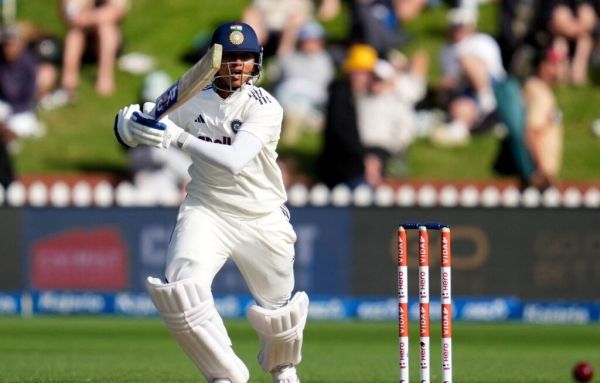
At the same time, if they cash in on the likely favourable batting conditions over the next two days, all will be forgotten and forgiven.Ignored in limited overs cricket, Yashasvi Jaiswal reminded the BCCI selectors of his ability to be aggressive yet consistent at the top of the order. His defence was initially unconvincing. So he switched to offence, peppering the offside boundary with magnificent drives off the front foot. He was dropped once, but rattled the fence no less than 16 times in a rollicking 89-ball 85.
New Zealand ended the pummelling by getting their stumper Tom Blundell to stand up to paceman Matt Henry, which forced the Indian to retreat from his comfort zone of playing off the front foot.
159 for one in only 39 overs at close of play on the second day, India were poised to take-off in the match.
The ever reliable KL Rahul, who could have been leg before had New Zealand asked for a DRS, was well anchored at the crease on 52. Speaking to media, Akash Deep highlighted the importance of Jaiswal and Rahul obtaining quick runs in the context of the match.
As for the 6th wicket issue, at this very Basin Reserve ground in 2014, a 6th wicket association between Brendon McCullum and Bradley-John Watling amassed 352 runs against India. Five years before that, Mahela Jayawardene and Prasanna Jayawardene had realised 351 runs in Ahmedabad. Last year, Harry Brook and Jamie Smith hammered 303 in Birmingham.
With pacer Mohammed Siraj, who has played 48 Tests, dropped for the match, the trio selected to support the redoubtable Jasprit Bumrah—namely Prasidh Krishna, Akash Deep and Anshul Kamboj—possessed a combined curriculum vitae of 20 Tests.
So, when Bumrah was unable to deliver a coup de grace, the others lacked the wherewithal to substitute for him.India’s tour selectors need to reflect on their decision to omit Siraj from the side. The Hyderabadi may not be a world class exponent, but he’s endowed with a heart and stamina and an uncanny ability to conjure a rabbit out of a hat. His heroic spell at The Oval in London last year – in the absence of Bumrah – is testimony to such talent.
In a limited 2-Test series there is little room for experimentation, especially since every outing matters for qualifying for the World Test Championship final, which India achieved in 2021 and 2023, but failed to replicate in 2025.
Presently, New Zealand, champions in 2021, lead the charge, with India lagging in fourth place. Only the top two sides at the end of the two-year round robin advance to the final.What the McCullum-Whatling stand at this venue underlined was how good the wicket can become at the Basin Reserve once it dries out. Dead grass doesn’t conspire with seamers. That is precisely what is happening in this Test. The devil of a green pitch is fast disappearing. The customary daily morning mowing of the wicket will shave off the grass further and render it flatter.
Weather fair for next two days
What that means is, if the Indian batsmen apply themselves, runs are there for the taking. The weather is set fair for the weekend and only on the fifth and final day on Monday is it expected to be windy and thereby of some assistance to swing bowling.
India’s best showing in Test cricket under coach Gautam Gambhir was in England last year, when they creditably drew a thrilling 5-test series 2-2. The basis of that success was the stability of their opening pair – K L Rahul and Yashasvi Jaiswal – extended. The 130-run stand between them on Friday afternoon served up another splendid start. They weathered the new ball threat from the Black Caps’ foursome. Indeed, a platform was laid for the likes of skipper Subman Gill and Rishab Pant to make hay while the sun shines.
Nicholls remained unconquered with a masterly, sheet anchor knock of 175. Washington Sundar picked in place of the seasoned Ravindra Jadeja because he is an off-spinner – so his stock delivery spins away from left handers – failed to disturb Nicholls. It would, though, only be fair to judge the Tamil Nadu all-rounder over a longer period of time and not on data in one innings. He, in fact, fulfilled his function of keeping it tight while providing breathers for the speedsters and injecting urgency to the over rate.
Phillips believes belies Sundar may have a greater role to play later in the match, for he believes the wicket – which according to him ‘is getting slower and lower’ – will eventually turn. He cited an instance of him and the Australian Nathan Lyon, both off-break bowlers, each capturing five wickets in a test at this venue.
He batted another 55 minutes in the morning, in course of which he completed his hundred, before an incoming ball from Akash Deep, bowled from the edge of the crease, straightened to hit the top of off-stump.
As is generally the case, Bumrah was again the pick of the Indian bowlers. With a four-wicket haul he was also the highest wicket taker. Akash Deep was, though, more economical, conceding only 2.30 runs per over in the 27 he sent down. But they weren’t able to banish India’s slight 6th wicket hurdle.





'Meeting PM Modi turned out to be very lucky': Suryakumar Yadav on redisovering batting form

Dinesh Karthik reveals the score India must keep New Zealand under in Wellington Test

'Dhoni has a lot more to contribute': Venkatesh Prasad backs former India captain's mentor role after IPL retirement

Siraj, Jadeja excluded from India’s playing XI in 1st Test, Kotak says ‘this is the best XI everyone felt’