

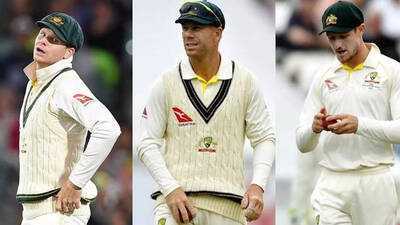
'WE ALL KNEW': Cameron Bancroft breaks silence on Sandpapergate, admits withholding truth to protect teammates and Cricket Australia
toi
newspoint|18-11-2026
Cameron Bancroft has broken his silence on the 2018 Sandpapergate scandal with a series of explosive revelations, claiming the entire Australian squad knew about the ball-tampering plot and admitting that he withheld crucial information during Cricket Australia 's (CA) investigation to protect his teammates and the governing body.
The former Australia opener, who was caught on television cameras using sandpaper on the ball during the Cape Town Test against South Africa in March 2018, has directly challenged the official version of events that held only he, Steve Smith and David Warner responsible.
In an account published in The West Australian, Bancroft wrote: "It was not just the three of us — Steve Smith, David Warner and I — who knew about me using sandpaper on the ball in South Africa. It was the whole team."
He also acknowledged that his account to CA's investigators was incomplete, saying he had deliberately withheld details to avoid implicating others.
"I did not give a complete and truthful account," Bancroft wrote. "I withheld important details, including when the use of sandpaper began, how long it went on for, and the involvement and awareness of others."
The admission comes amid renewed scrutiny of the scandal following Usman Khawaja 's autobiography, Sabr, in which the former Australia batter claimed the entire team knew about the ball-tampering. Bancroft's account now adds weight to Khawaja's allegations, which have been backed by Warner but strongly disputed by current Australia captain Pat Cummins and other members of the bowling attack.
ALSO READ:
Cummins' press conference was the final straw
Bancroft said Cummins' recent press conference, in which the Australia captain rejected Khawaja's claims and criticised his former teammate for being irresponsible with people's lives and reputations, prompted him to speak publicly.
"The final straw for me to write this account was Australian cricket captain Pat Cummins’ press conference," Bancroft wrote. "It made me feel angry, betrayed and alone."
He added: "What I saw, experienced and lived with - not only him, but everyone else on that tour in South Africa - is not the public account he gave in his press conference and in the years previously when he has spoken on this time."
"In addition to what Usman already mentioned I have key recollections which affirm what he is saying."
Bancroft said he had become the "scapegoat for the entire team", adding that nobody at a meeting after the Cape Town Test had stood up to say they were completely unaware of his use of sandpaper.
ALSO READ:
Bowlers knew about the ball's condition, Bancroft claims
The 33-year-old also detailed regular conversations with Australia's fast bowlers Pat Cummins, Mitchell Starc , Josh Hazlewood and Mitchell Marsh, as well as wicketkeeper Tim Paine, about the ball's condition and whether it was reverse-swinging.
"During that period, I regularly spoke to the bowlers about how the ball was behaving. I had to," he wrote. "I recall conversations with all the fast bowlers Pat Cummins, Mitchell Starc, Josh Hazlewood and Mitchell Marsh about whether it was reverse swinging enough."
He said the feedback influenced how much sandpaper he used.
"All the bowlers gave me feedback if my work on the ball was working. It was helpful."
"Is it going yet? It’s not going yet, it needs more. So I would use the sandpaper more on the ball."
Bancroft also alleged that bowling coach David Saker had encouraged him, while media manager Kate Hutchison was the only person in the touring party who openly objected to the practice.
"I received wraps and encouragement from members of the playing and coaching staff, especially David Saker," he wrote.
He recalled Hutchison making it clear that she believed the practice was wrong and walking away from the discussion. "Somebody had spoken up," he wrote. "And I ignored it."
ALSO READ:
Sandpaper plan discussed in dressing room
Bancroft said sandpaper was first used during the second Test against South Africa in Port Elizabeth, with Warner proposing that he take responsibility for using it because the cameras were paying close attention to him.
He recalled that Saker and then-coach Darren Lehmann were present when the proposal was discussed.
"I recall people in the room agreeing with the proposal. Saker and Lehmann were certainly present, although I cannot speak for every word shared," he wrote.
Bancroft said he felt "uncomfortable and compromised" but went along with the plan, knowing it was wrong. He also claimed Smith "wanted no part" in the discussion and had "distanced himself".
He further alleged that after he was caught in Cape Town, team members and staff, including Saker, urged him to lie about what he had used on the ball. Bancroft said his subsequent explanation that he had used yellow tape to collect granules from the pitch was something he now looked back on "with enormous regret".
"We were frightened. We were under pressure. We were trying to manage a situation that was rapidly getting away from us," he wrote.
Recalling the moment 12th man Peter Handscomb came onto the field to remove the sandpaper, Bancroft said Handscomb told him: "I think it’s time I take that off you now". He added that Lehmann had shouted over the walkie-talkie: "get the f***ing sandpaper off Bangers now".
"In my opinion, if he didn’t know he wouldn’t have said that," Bancroft wrote. "Once again. WE ALL KNEW."
Bancroft also claimed that ball-tampering practices had become part of the team's routine, saying players had been instructed to push the quarter seam of the ball together after every wicket.
He said the scandal had "destroyed" his career. He has not played Test cricket since the 2019 Ashes, despite continuing to score heavily in the Sheffield Shield.
CA announced on Wednesday that it would establish an independent forum for players and staff involved in the 2018 South Africa tour to share their accounts. The initiative is not a fresh investigation and will not lead to new sanctions; the board will decide what information can be made public.
Related News




Latest Newsmore
IPL 2027 Retention LIVE: Dhoni retires, Starc and Head released; full players list, trades and auction purse
18-Nov-2026 • Samira Vishwas

IND vs NZ 1st Test: Will Mohammed Siraj play first Test against New Zealand? Morne Morkel leaves final call to Shubman Gill
18-Nov-2026 • toi

'We need to block outside noise': Morne Morkel's message to Team India ahead of first Test vs New Zealand
18-Nov-2026 • toi

Pakistan Great's Big Praise For MS Dhoni After IPL Exit, New CSK Role
18-Nov-2026 • Prateek Thakur
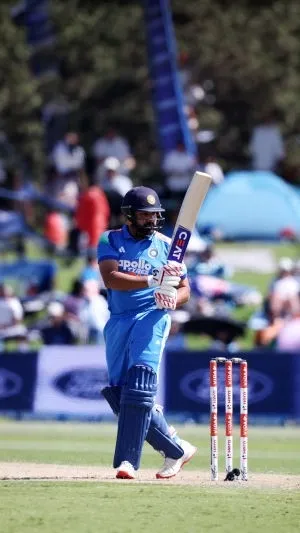
Rohit goes from super to subdued in New Zealand
18-Nov-2026 • Karthik Krishnaswamy