Samira Vishwas
Tezzbuzz|12-11-2026
Diwali week should have ignited special celebrations for a rare ‘Double Dhamaka’ in Indian badminton. Instead, it has seen fireworks of a different kind as a heated debate has erupted over who should pay for its players.
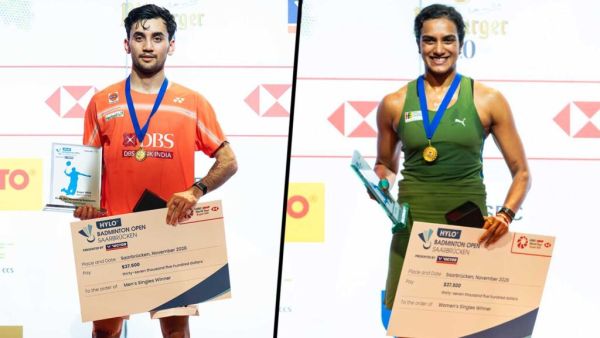
PV Sindhu and Lakshya Sen gave Indian badminton a memorable double triumph, winning the women’s and men’s singles titles, respectively, at the Hylo Open in Germany. Sindhu beat Denmark’s Line Kjaersfeldt 21-12, 21-14, while Lakshya defeated defending champion Jonatan Christie of Indonesia 21-17, 21-10.
For Sindhu, it was her second title of the season and a welcome return to winning ways. Lakshya, meanwhile, ended a year-long wait for a BWF title. There were other encouraging performances too, with Ashmita Chaliha defeating former world champion Akane Yamaguchi at the French Open and Anmol Kharb reaching the semifinals at the Hylo Open.
Funding row
Yet, far from celebrating the string of terrific successes by our shuttlers, the headlines were soon dominated by an unseemly funding row involving the Sports Authority of India (SAI), the Badminton Association of India (BAI) and the players who had just completed a demanding European campaign.
Also read: Hardik Pandya moves to Punjab Kings, MI gets Arshdeep Singh in IPL swap
The issue was straightforward. Indian shuttlers travelling for tournaments in Finland, Denmark, France and Germany were left to arrange their own finances after expected government funding failed to materialise. Some players were forced to withdraw from these tournaments, while others competed without their coaches. The episode triggered a hot debate over whether established professionals such as Sindhu and Lakshya should be asked to finance their own international tours.
There is a reasonable argument to be made here. Public money comes with responsibility, and professional athletes who earn prize money and have sponsorship deals should aim towards financial independence. Government support can’t be an open-ended arrangement, especially when public funds are involved.
Huge difference in tennis, badminton prize money
But the argument becomes trickier and more complicated when we look at the economics of professional badminton and the circumstances of budding players who are still striving to establish themselves. Sindhu herself acknowledged this in her response to the controversy. She highlighted the enormous difference in prize money between tennis and badminton. A first-round exit at Wimbledon earns a player British pounds 80,000, she noted, while winning one of badminton’s richest tournaments, the China Open, brings in around USD 140,000. A first-round exit at the same badminton tournament earns barely USD 2,000. The expenses, however, remain substantial. Players have to pay for international travel, accommodation, coaches, physiotherapists, trainers and other support staff.
Sindhu also made an important admission. She has been fortunate to have sponsors and the backing of organisations such as Olympic Gold Quest (OGQ), which allow her to manage her tours. But as she underlined in a social media post, many younger players do not have that privilege. As such, Sindhu’s question was simple yet critical: what happens to an 18-year-old hoping to become the next Sindhu or Lakshya?
Also read: Warner backs Khawaja’s claims on ‘sandpapergate’, Starc denies
There are recent examples that make Sindhu’s argument difficult to dismiss. Tanvi Sharma, who won silver at the World Junior Championships last year and is one of India’s most promising young shuttlers, reached the quarter-finals of the Denmark Open during the European campaign. But she had to play without a coach. Similarly, Ashmita Chaliha had no coach but just a fellow Indian shuttler Isharani Baruah in her corner when she defeated Yamaguchi at the French Open.
Young players need institutional support
Several players also withdrew from key tournaments as the financial uncertainty continued. These are competitive disadvantages that can have a bearing on a player’s development, particularly when international tournaments are essential for gaining ranking points and experience.
The concerns extend beyond the senior circuit. India’s 30-member contingent for the World Junior Championships in Cairo also faced uncertainty over funding issues and nearly missed the trip before BAI arranged the money. The team eventually travelled and Jagsher Singh Khangurra bagged a bronze medal. These are precisely the players who need institutional support the most. They are still building their careers and are unlikely to have the sponsorship deals or financial backing available to established superstars like Sindhu or Lakshya.
In addition, there is another young name worth remembering. Fifteen-year-old Tanvi Patri recently became the first Indian woman to reach the badminton final at the Youth Olympic Games in Dakar. She eventually won silver after a remarkable fight against China’s Zhang Yi Xin, saving five match points and coming back from 10-19 down in the deciding game before losing 24-26. It was a remarkable performance and another reminder of the talent coming through in Indian women’s badminton.
These achievements make the timing of the funding debate particularly pertinent. India has young players capable of competing with the best in the world. Instead of bogging them down with financial worries, the challenge is to give them the support and opportunities needed to sustain that progress.
Last year, India’s legendary coach and badminton great Pullela Gopichand had raised a concern when he cautioned middle-class parents against putting everything into a sporting career. His argument was rooted in the financial insecurity faced by athletes who do not make it to the very top, the limited employment opportunities available to sportspersons and the absence of adequate alternative career pathways. He wanted families to think carefully before making an all-or-nothing investment in sports other than cricket in India.
Proper system needed
That warning deserves to be revisited in the context of the current controversy. If a young player needs years of international exposure to improve, build a ranking and attract sponsors, how is that journey to be financed? Expecting athletes to become financially independent before they have established themselves puts the burden on precisely the people who need support to progress.
Also read: Shami retires from Test cricket, to play in white-ball formats
This does not mean every player or every tournament must automatically receive government funding. There has to be a proper system of selection, performance assessment and financial accountability. SAI has maintained that the European tour funding was not released because BAI failed to submit the required proposals within the stipulated 30-day deadline. SAI has also indicated that funding for future tournaments would be restored, though players would not be reimbursed for the expenses they have already incurred. If the federation missed the deadline, it must answer for that lapse. Athletes should not have to bear the consequences of administrative delays over which they have little control.
There is also a larger question about how India wants to fund sport. Established athletes such as Sindhu and Lakshya can be encouraged to build independent financial support through sponsorships and prize money. But the same expectation can’t be applied to junior players or someone outside the top rankings. A country’s sporting ecosystem needs to support athletes at different stages of their careers. Development funding and elite athlete funding have different purposes, and both deserve careful attention.
Indian badminton has spent years building a strong international presence. The country has produced Olympic medallists, world champions and players capable of challenging the very best. That progress has required investments from governments, federations, private sponsors and organisations such as OGQ. While it would be silly to overlook that support in discussing financial independence, it must also be ensured that players are not made to bear the cost of bureaucratic delays or clash of egos among sports bodies.
There is plenty of talent and ambition in Indian badminton. After all, today’s young shuttlers are tomorrow’s champions. Beyond talent and hard work, they need opportunity and financial support to hone their skills and get to the top!
(The Federal seeks to present views and opinions from all sides of the spectrum. The information, ideas, or opinions in the articles are of the author and do not necessarily reflect the views of The Federal.)


WATCH: Hardik Pandya's MI Chapter Ends! Mumbai Indians Share Emotional Farewell Video

Hardik Pandya Trade Confirmed! Star All-Rounder Gets New IPL Home In 18 Cr Trade
Virat Kohli won't retire after 2027 ODI World Cup, claims childhood coach Rajkumar Sharma

Sandpapergate row: 'Not going to answer that' - Usman Khawaja cancels media interviews after Pat Cummins question