Samira Vishwas
Tezzbuzz|06-11-2026
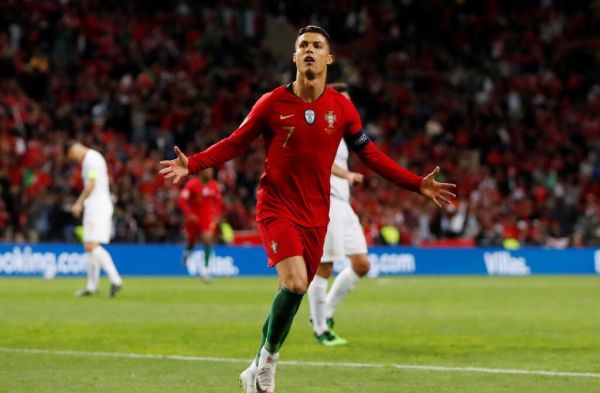
It may seem unbelievable to his legion of fans worldwide, but 41-year-old Cristiano Ronaldo’s run with Portugal is now officially in the history books. CR7, as he is affectionately called, announced his retirement from international football in a heartfelt video letter on Instagram on Thursday (November 5).
His 23-year tenure with Portugal inspired a generation of young footballers in a country that had long produced great players but was still waiting to win a major senior international trophy. Little did then Portugal manager Luiz Felipe Scolari know that the young recruit he brought into the squad in 2003 would go on to help the country win its first. Euro, that is!
Scolari had included an 18-year-old Ronaldo in the squad alongside goalkeeper Bruno Vale, another newcomer. Interestingly, Scolari said the two youngsters had been selected so he could observe them and assess whether they could contribute to the national team in the future.
Also read: Cristiano Ronaldo suspended for 30 days, fined after Portugal camp walkout
Ronaldo made his international debut in Chaves, Portugal, against Kazakhstan on August 20, 2003. He started on the bench and came on at half-time as a substitute for Rui Costa. Within a minute of entering the pitch, he produced a mazy run that ended with a powerful cross-shot across goal.
In a later interview with UEFA, Ronaldo recalled that his international debut came during one of the best weeks of his life. He remembered his mother being the first to tell him he had been called up, before his agent, Jorge Mendes, confirmed the news. It marked the beginning of a relationship with his country that would span more than two decades.
The dream that began in 2003 faced its toughest challenge a year later. After Portugal lost the Euro 2004 final to Greece, a 19-year-old Ronaldo wept openly on the pitch. Twelve years later, Portugal won the UEFA European Championship, the country’s first major senior international trophy.
The Portugal he inherited, the Portugal he leaves behind
Portugal has always had a rich football history. The team announced itself on the global stage at the 1966 World Cup in England. Led by Eusébio, Portugal finished third, its best-ever World Cup performance. Eusébio scored nine goals and won the tournament’s Golden Boot.
Also read: Cristiano Ronaldo marries Georgina Rodriguez after 10 years together
Portugal’s youth teams won back-to-back FIFA U-20 World Cups in 1989 and 1991. Many of those players went on to form what became known as the Golden Generation, featuring Luís Figo, Rui Costa, João Pinto and others.
They helped Portugal reach the semi-finals of Euro 2000. By 2004, with Ronaldo emerging alongside established stars, Portugal reached the European Championship final on home soil, only to lose to Greece.
Despite all the progress, Portugal still had unfinished business. FIFA described the period before Ronaldo’s international debut as one in which the country had made only three World Cup and three European Championship appearances.
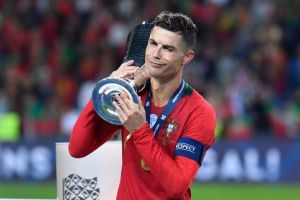
Portugal has a much stronger trophy cabinet today than it did in 2003. The country has won the European Championship and two UEFA Nations League titles. More importantly, expectations surrounding the national team have changed.
The transformation, however, did not happen overnight. In September 2014, Portugal began its Euro 2016 qualifying campaign with a shock 1-0 defeat to Albania. The players were booed off the pitch by their own supporters, and manager Paulo Bento was subsequently dismissed. Yet, in July 2016, the same national team defeated hosts France in Paris to win its first European Championship.
There was perhaps no moment that captured Ronaldo’s journey with Portugal better than the Euro 2016 final. Twelve years after breaking down in tears following the defeat to Greece, he returned to the European Championship final as Portugal’s captain. However, a knee injury forced him off the pitch in the 25th minute against France. As his teammates continued the contest, Ronaldo remained on the sidelines, visibly emotional, encouraging them and urging them forward. When Eder scored the decisive goal in extra time, Ronaldo celebrated alongside his teammates as Portugal lifted its first major senior international trophy. The 19-year-old who had once cried over a lost final was now the captain of a team that had finally won one.
Also read: Cristiano Ronaldo bows out in tears as Spain end Portugal’s World Cup campaign
By the time Portugal arrived at Euro 2024, the change in public perception was evident. Roberto Martínez’s side had won all 10 of its qualifying matches, scoring 36 goals and conceding just two. Portugal now became one of the favourites to win the tournament.
The shift in expectations was perhaps best captured by Bruno Fernandes before the competition. Speaking about the criticism surrounding the team, the midfielder said he welcomed it, seeing it as a sign that supporters expected more from Portugal.
“I like a bit of this negativity around the national team, ‘the team isn’t as good any more’, ‘it’s still not what we want’. I like it because it’s a sign that people expect a lot from us,” he said at a press conference ahead of Euro 2024.
Portugal went on to add a second Nations League title in 2025, defeating Spain in the final after beating Germany in the semi-finals. The team had established itself as a contender, with a generation of players who knew what it meant to win at the highest level.
Passing on the torch
The next generation of Portuguese footballers is starting from a very different place than Ronaldo did as an 18-year-old from Madeira. Players such as Bruno Fernandes, Bernardo Silva, Rúben Dias, Nuno Mendes and João Neves have grown up in a Portugal that has already won the European Championship and the Nations League.
Ronaldo grew up watching a country with great footballers that was still waiting for a major trophy. The younger generation has grown up watching their country lift them.
For many of these players, Ronaldo was the footballing idol they grew up watching. Bruno Fernandes, for instance, was only nine when Portugal lost the Euro 2004 final to Greece. He has said seeing Ronaldo in tears that night left an impression on him, and that the forward’s work ethic and winning mentality became a source of motivation.
Now that Ronaldo has stepped away from international football, it is players like Fernandes, Bernardo Silva and Rúben Dias who must carry Portugal’s ambitions forward. They inherit a national team that knows what it takes to win major tournaments, but whose supporters have also come to expect success.
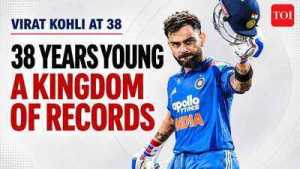
Virat Kohli's 38th birthday, 38 stats: The King, the records and a legacy like no other
11 years after Rishabh Pant got the nod, Mohit Ahlawat scripts a comeback with maiden first-class ton
Meghalaya field completely new team for Ranji Trophy match after High Court order
834 runs in six innings! Chinmay Sutar creates first-class cricket history