Samira Vishwas
Tezzbuzz|02-11-2026
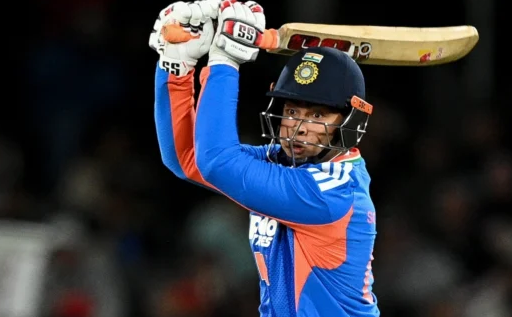
The second T20I between India and New Zealand in Christchurch marked the first time Vaibhav Sooryavanshi batted at No. 3 in his career. And he looked completely at sea. Eight balls, seven minutes and four runs. Welcomed with a 143.5 kmph bouncer and dropped once, Sooryavanshi eventually offered a simple catch and departed. After the long layoff, a break in concentration was understandable. He looked far more assured in the next game, smashing a 19-ball 45, but was overshadowed by Abhishek Sharma’s whirlwind century. Two days later, Sooryavanshi was back to square one, dropped to make way for the returning Ishan Kishan.
The Indian think-tank’s message is clear: he is not a first-choice in this T20I team.
Meanwhile, not too far from Auckland, another bunch of Indian players was getting ready to face New Zealand, in a different format, wearing different colours and using a different ball. KL Rahul, Yashasvi Jaiswal, Mohammed Siraj and now, even Nitish Reddy.
It’s not the team Sooryavanshi is part of, but one he would arguably have benefited from far more. Legends aside, think of some of the most promising names in Indian cricket today – Rishabh Pant, Sanju Samson, Devdutt Padikkal and Kishan. What do they and the path to playing top-level cricket for India have in common? India A. Unfortunately, Sooryavanshi isn’t part of that pathway.
India A, considered one of the most important breeding grounds for cricketers, is missing one of its most exciting young prospects. It’s not that Sooryavanshi was never considered for India A. In May, he earned his maiden call-up for the tri-series in Sri Lanka, but just two months later was elevated to the senior team, making his international debut in England. Between those two landmark moments, Sooryavanshi played just five matches, with a match-winning half-century in the final and a heated post-match incident being the only two notable talking points.
Too good for India A, not yet a T20I regular?
Which prompts the question: Why is Sooryavanshi not playing for India A? The argument becomes all the more relevant given that he isn’t a regular in the playing eleven. Surely, an India A stint would mean more game time, an opportunity to rub shoulders with established stars, face the moving red ball and experience the ebbs and flows of good old-fashioned red-ball cricket. The way Devdutt Padikkal and Sai Sudharsan dug in to help India A recover in the first unofficial Test at Lincoln, the prospect of watching Sooryavanshi put a price on his wicket would’ve been a sight to behold.
“Guys like KL and Rishabh prefer to play at least one game for India A even today. The competition level, if not the same, is better than in India’s first-class cricket,” former India A fielding coach Abhay Sharma, who was part of the India A coaching set-up under Rahul Dravid, told HT.
Sharma had already been part of the India A set-up for two years when Dravid took over as its head coach in 2015. That team featured several of today’s household names, including Samson and Axar Patel, alongside others whose careers eventually faded – Unmukt Chand, Naman Ojha and Sandeep Sharma. Some of these players owed their big break with the Indian team to a well-established channel of communication between the two head coaches – Dravid of India A and Ravi Shastri of the senior men’s team.
“Everything used to happen in a very smooth and calculated manner when it came to the transition of players. Whoever performed exceptionally well, depending on the conditions and the tempo of the game, would be recommended for the senior team. Rahul used to take our views and speak to the selection committee or Ravi Shastri,” said Sharma.
For Sooryavanshi, Sharma reckons game time is the need of the hour. If that comes through India A, so be it.
“Any cricketer who is sitting on the bench is better off playing some form of cricket or the other. But, on the other hand, the national team needs to have at least 15 players. Vaibhav is at a stage where he is still developing. So, if he is not in the playing eleven and an India A tour is happening simultaneously, it makes sense to give him game time in those conditions,” he said.
“Red-ball cricket is the base, and if the base is strong, a very solid foundation is laid. Whatever we have seen of Vaibhav, he is doing well in the shorter formats, but there is still technical work required. When you play too many shots, the opposition starts identifying your weaknesses and works out a plan against you. Red-ball cricket is very important for Vaibhav.”
A quick glance at some of the previous India A players lends weight to Sharma’s argument. With 869 runs from 11 innings, Rahul averages 48.28 in red-ball India A games. Hanuma Vihari scored 1,146 runs in 15 matches at an average of 57.3. Pant, with 473 runs in six matches, also averaged a healthy 52.56. While Pant used that experience to establish himself as a Test great for India, Vihari had his moments too. His 66-ball 8 while opening the innings against Australia at the MCG, and the dogged 23 off 161 balls three years later at the SCG, were lessons in attritional cricket. To suggest that Vihari’s India A experience had little role in shaping these two Test epics would be rather unfair.
Jaffer wants to see more of Sooryavanshi
However, long before these four players became regulars in the India A setup as they progressed through the ranks, things were very different for the old-timers. Wasim Jaffer, the leading run-scorer in Ranji Trophy history, recalled how challenging it was.
“The importance of India A has changed drastically from what it was back in the day. Earlier, there was a proper channel for progression. If you did well in the Ranji Trophy, you would get a chance in the Duleep Trophy or the Deodhar Trophy. Only then would you be considered for a place in the touring India A team. Now, a lot of India A players are selected on the basis of the IPL, which is both good and bad, I feel,” Jaffer told HT.
As for Sooryavanshi, Jaffer too wants to see Vaibhav play for India A. Then again, there’s a catch.
“The channel of communication is still there. If anything, it has gotten better. As far as I know VVS Laxman, he is certainly in touch with the decision-makers. I’m sure some of the selectors are in New Zealand as well to track how not only Vaibhav, but also the other youngsters, perform,” he added.
“I too want to see Vaibhav play for India A because red-ball cricket is the only format in which he is yet to be truly tested. Then again, Vaibhav is like a double-edged sword for the Indian team management because he is the first-choice replacement if any of the guys are unavailable. Anytime Kishan, Samson or Abhishek is unavailable, the question will be, ‘Where’s Vaibhav?’”

Kolkata Knight Riders re-enter race to sign Hardik Pandya: Report
IND vs NZ, 5th T20I: Seifert, Phillips power New Zealand to 7-wicket win; India takes series 3-2
Jemimah Rodrigues Declared Fit After 3-Month Injury Layoff, Joins Mumbai Team

Ayush Badoni turned to meditation, only red-ball practice ahead of breakout season