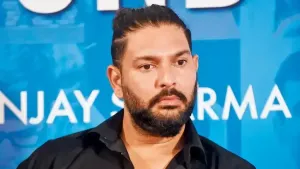
The ‘10-year challenge’ trend may have faded from social media a while ago, but Rajneesh Gurbani could have a lovely submission for it.
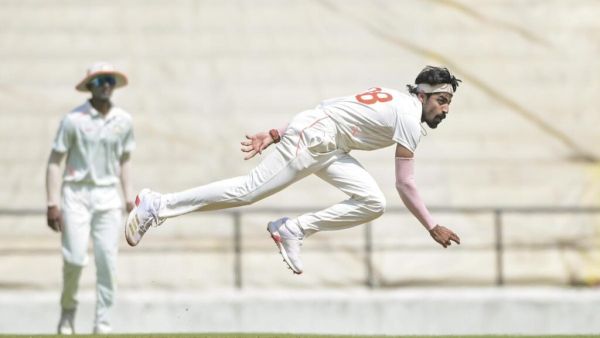
As the 33-year-old charged in to bowl the first ball of his spell on the second day of Vidarbha’s Ranji Trophy match against Goa, it marked exactly 10 years since his First-Class debut against Jharkhand in 2016.
In the decade since, he has carved out a reputation as one of the finest red-ball bowlers on the Indian domestic circuit, built on his consistency of line and length and ability to extract movement. He has won the Ranji Trophy and Irani Cup twice, and claimed 143 dismissals in 44 appearances at a miserly average of 22.43.
“It’s very nice, and a lot has happened (since then)! But when I look at my body now, after 10 years, I feel as fresh as when I debuted,” Gurbani told Sports stars on a pleasant evening in Nagpur.
“I’ve gained so much experience over the last 10 years; I’m a much more mature bowler today. I know which situations to bowl in, and what attitude I need to bowl with. I’m prepared, and I am enjoying cricket; that’s more important.”
The match against Goa at the VCA Jamtha Stadium was Gurbani’s first appearance in his hometown of Nagpur since returning to Vidarbha after a two-season stint with Maharashtra.
His time with Maharashtra yielded 25 First-Class wickets at an impressive average of 19.88 across two seasons. But the move back offered him the chance to return home, an opportunity he has relished.
“I’m really grateful to the Vidarbha Cricket Association for giving me this opportunity,” he said. “Playing at home is always very special; I don’t think any feeling can beat it. I’m also really grateful to the Maharashtra Cricket Association for giving me the opportunity to play for a couple of years.”
Gurbani also noted that the Vidarbha team management had not assigned him a specific role, but he was confident that opportunities would come his way.
“I knew I was bowling well and I just wanted an opportunity to play. Once I felt that if I performed well I would get an opportunity, I was confident I could,” he explained. “I know if I am at my best and my body is performing well, I can be very useful to Vidarbha, and I want to give my best.”
His return came in Vidarbha’s second match, against defending champion Jammu and Kashmir in Srinagar. He claimed three wickets and scored his maiden First-Class fifty in the game. Walking in at 133 for seven, with Vidarbha trailing by 127 runs, he added 136 runs with R. Samarth to help set up an eventually nerve-wracking three-wicket win.
“I was a little emotional, but the moment when the ball was in my hands, I wasn’t thinking about much. I was just very happy to be back playing,” he explained. “Maybe there were some emotions, but it just went away when the ball came, and I was in my zone.”
Elder brother in pace pool
Gurbani was a central figure in Vidarbha’s maiden Ranji Trophy triumph in 2017-18, taking 39 wickets across the season at 17.12 per dismissal. He was named Player of the Match in the quarterfinal, semifinal and final on the way to the title.
The season also gave him the opportunity to play red-ball cricket alongside Umesh Yadav, who had been an inspiration to him from a young age.
“Initially, I didn’t know any fast bowlers; I used to watch Australian fast bowlers bowling. Then, when I was around 12 years old, my coach told me that we needed a fast bowler for the school team, so I started fast bowling. But when I saw Umesh Yadav bowl in the Ranji Trophy when I was around 16-17 in Jamtha, I got really motivated,” he reminisced.
“I thought that fast bowling is great and my dream was to just play alongside him and bowl new ball with him. That was really a motivation at the early stages.”
At 33, Gurbani is now the senior-most member of an impressive Vidarbha seam attack featuring Yash Thakur, Nachiket Bhute, Darshan Nalkande and Praful Hinge. All four have begun making inroads into the Indian Premier League (IPL) and national setups, and the group shares something of a sibling-like bond.
“I was in the squad in 2017-18, when all of them started coming one-by-one, and I used to feel like an elder brother to them,” he explained. “Obviously now I’ve come back, and they all have their positions, but whenever I see them, I feel they are my younger brothers. I feel very connected to them.”
The depth of the attack leaves little room for complacency, a challenge Gurbani is keen to embrace.
“When I came back, I was not thinking about being better than anyone. My attitude was just that I want to enjoy the game, and if someone is better than me it’s time to give them the baton,” he said. “But at the same time, I want to ensure that my fitness level and skill level are up there. I want to be that competitive, not just be a senior player. But if I can contribute anything for these youngsters with my experience, I would want them to have it.
“The competition is quite tough, and with the bench strength, if anyone gets an opportunity, they’re all pushing each other, so there is very healthy competition.
“You are never satisfied. For example, if I’m a good bowler but not a good fielder and batter, there is a chance you might get dropped. So when I see that, I have to push myself to that level.”
Development with the white ball
Gurbani is primarily known as a red-ball bowler. He did not feature in last year’s Vijay Hazare Trophy for Maharashtra, while his last appearance in the Syed Mushtaq Ali Trophy came back in 2019, before his move.
However, in recent years, he has turned out for Kolhapur Tuskers in the Maharashtra Premier League and Nagpur Heroz in the Vidarbha Premier League. He has also worked as a net bowler for IPL teams Rajasthan Royals and Delhi Capitals.
“When I started playing cricket, I was playing cricket with the red ball, so I had around 15 years of experience with that. But doing these camps and net bowling has improved my white-ball bowling, and that has definitely helped me with the red-ball as well,” he said.
“For example, in our last match against Goa, we were bowling a lot of cutters and yorkers, and those white-ball skills really helped. I have the confidence that if I want to bowl a cutter or yorker now, I have practised it for the last three or four years.”
Those skills stand him in good stead in a domestic game that, in his estimation, has become increasingly attack-minded, with both batters and bowlers adopting more aggressive approaches.
“Initially, in 2016-2017, there were fewer aggressive batters and bowlers; they tended to be a little safer, but now players have become more aggressive in their mindset. If a batter isn’t comfortable playing the ball, they will try and smash it, and if a bowler goes for two boundaries, they will try and take a wicket rather than trying to bowl tight and economically,” he explained.
ALSO READ | Manish Pandey back for Karnataka: Former captain included in probables for SMAT
“A bowler with good white-ball skills has a couple of variations to use at that time. If you have a couple of good variations, it puts doubt in the batter’s mind and makes them tentative. If you don’t have those skills and you keep bowling the same length, you might run into some issues.”
Gurbani also pointed to Bhuvneshwar Kumar, who recently earned a national recall at the age of 36 on the back of his IPL performances, as an example of how he could continue to develop his own game.
“I try to see what he is adding to his bowling. He is consistently playing at a high level, playing IPL, and he has got a comeback call from India. That’s a big motivation for us also, thinking age is just a number. You don’t expect much; you keep doing your job. I have seen him saying in his interview that basically I am just trying to do the same thing, not getting attached to anything, and just doing my job,” he said.
Rest and recovery
Another significant change Gurbani identifies between the early days of his career and the present is the growing emphasis on rest and recovery in domestic cricket.
“The importance of hydration and sleep has changed. Back then, we used to think that even if we didn’t hydrate or sleep properly, we’d still be able to play. But now following this has become a basic criterion,” he noted. “People do good priming sessions in the gym, activating their bodies and strengthening the muscles that get weak during four-day matches.”
He considers these changes crucial to his longevity.
“I’ve changed my habits so that I don’t have to alter anything before a match now. Year-on-year, my lifestyle has become centred around cricket,” he explained. “I don’t sleep at 12:00 when there isn’t a match. I have the same routine of sleeping and waking up.”
“Initially, I would switch off completely if there wasn’t a match, but now I have a routine in terms of sleeping and eating habits. I don’t eat anything different before or during matches because my diet is the same. I do it all 365 days of the year.”
Enjoying the game
Gurbani played five matches for India A in 2018, but higher honours have remained elusive. He has since learnt to focus on what he can control: his fitness, performance and enjoyment of the game.
“I have spent a lot of time thinking about whether I should continue playing cricket or not. But whenever I have those feelings, I call my gurus, and they make me feel that there is a lot of potential in me. When I have that feeling, I think that my body is doing well, and whenever I’m on the ground, I am motivated and enjoy the game,” he mused.
“I have stopped thinking much about playing at a higher level, playing in the IPL, or anything else. I just want to enjoy the game and play as many matches as I can. That is what gives me motivation.”
Playing at home, with his family around him, has made the return even more meaningful.
“I’m so grateful to the VCA because I get the opportunity to play at home, which is one of the best feelings. I’ve been away and experienced missing my family, and while I did enjoy those days as well, there’s nothing better than being at home.
I’m just in the moment. I don’t know what will be next for me, but I’m just going to enjoy things. I know something good is going to come.”