
Prateek Thakur
abplive|21-10-2026
IND vs NZ 1st T20I: Bhuvneshwar Kumar's return to India's T20I setup has given the team an experienced new-ball option ahead of the opening match against New Zealand. After his comeback match against the West Indies was washed out, the veteran pacer will be eager to make his presence felt if selected for Thursday's first T20I.
The question is whether India will hand him the new ball from the outset. Given the conditions expected in New Zealand and Bhuvneshwar's ability to move the ball in the air and off the surface, there is a strong case for making him the team's first-choice new-ball bowler.
Why Bhuvneshwar Kumar Could Be India's Biggest New-Ball Weapon In NZ
New Zealand has traditionally offered fast bowlers opportunities to exploit swing, seam movement and bounce, although the degree of assistance varies with the venue and weather. Such conditions could suit Bhuvneshwar's strengths, particularly with the harder new ball.
His greatest value is not simply his ability to swing the ball. It is his control over line, length and movement. When the conditions offer even a little assistance, he has the skills to make batters play, challenge the outside edge and create opportunities without relying exclusively on raw pace.
That makes him a compelling option for the opening overs. Rather than asking him to match the speed of India's quickest bowlers, the team can use his movement and accuracy to put early pressure on New Zealand's top order.
Of course, favourable conditions alone cannot guarantee wickets. Bhuvneshwar will still need to find the right lengths and make the most of whatever movement is available. But if India want a specialist who can exploit the new ball, his skill set makes a persuasive case.
Two Overs Up Front, Two At The Death
Bhuvneshwar's case extends beyond the opening overs. Modern T20 cricket demands bowlers who can operate during the powerplay and return when batters are looking to accelerate at the death.
In the IPL, where pitches are often batting-friendly, he has regularly been trusted with difficult overs at both ends of the innings. Bowling two overs up front and two towards the end requires more than technical ability. It demands experience, an understanding of match situations and the discipline to execute plans under pressure.
That versatility could be particularly valuable for India. If Bhuvneshwar can use the new ball effectively in New Zealand, the team would also have an experienced option to manage the closing overs. His control and variations could offer a different dimension to an attack built around pace.
However, his precise role will depend on India's combination and the conditions at the venue. Being capable of handling both phases does not automatically mean he will be assigned four overs in those roles.
Comeback Match Washed Out: Will Bhuvneshwar Get Another Chance?
Bhuvneshwar returned to India's playing XI for the fifth T20I against the West Indies after Arshdeep Singh suffered a shoulder injury.
It was his first international appearance since November 2022, but rain brought the contest in Bengaluru to an early end.India had reached 118/5 in 7.4 overs when play was abandoned. Bhuvneshwar therefore had no opportunity to bowl in the match, leaving his return without the chance to demonstrate what he could offer on the field.
The first T20I against New Zealand presents another potential opportunity. His selection in playing XI is not confirmed, and India's management will have to weigh his experience against the available bowling options. Yet, if the team prioritises swing and control with the new ball, Bhuvneshwar has a strong argument to be considered first.
For a bowler whose strengths align with the conditions expected in New Zealand, this could be an opportunity to remind everyone why his skill set remains relevant at international level. The final decision rests with the team management, but the case for giving him the new ball is difficult to ignore.


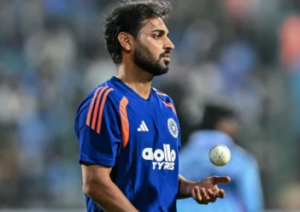
After four years away, Bhuvneshwar Kumar has a numbers-backed case
Samson booked the entire theater for Rajinikanth's 'Jailor 2', know the special reason

Hardik Pandya’s heartwarming response to a fan’s nearly 2,400 km walk captivates India
Australia on backfoot due to Bavuma's century in the second test, South Africa made a huge score