

Sandy Verma
Tezzbuzz|04-10-2026
The scorecards tell one story; the numbers tell another, much more sobering one.
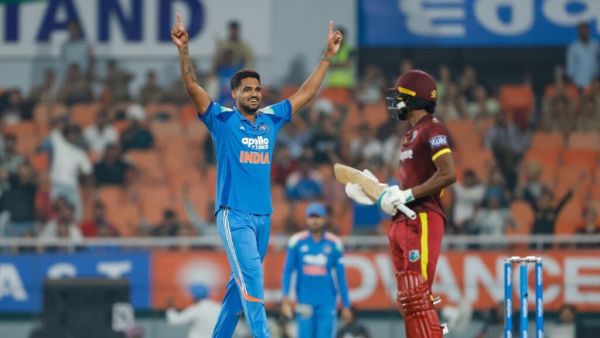
When India won the ODI series against the West Indies recently 2-1, most headlines were about the innings the Indians scored in victory. But the headlines don't show that, across the three matches, the Indian bowlers were bowled for a combined total of 1,050 runs.
For the Indians, who have their eye set on the 2027 ODI World Cup in South Africa, it was a wake-up call.
The Anatomy of a Run-Fest for India
The series got off to a deceptive start in Thiruvananthapuram when the West Indies were bundled out for just 295.
Kuldeep Yadav's 4 for 40 from his 10 overs was a masterclass in wrist-spin.Any feeling of security was soon dispersed in Guwahati, where the visitors went on a rampage, posting a record 405 for 7. Every Indian bowler gave away more than a run-a-ball, with Gurnoor Brar conceding 96 and debutant Auqib Nabi 84.
The final match in New Chandigarh provided no respite, either, despite a strong 351 by the home side. Shai Hope, batting for the West Indies, scored an unbeaten 162 as his team chased down the target with 10 balls to spare. It was their highest successful run-chase in ODI history.
Series Bowling Breakdown At a Glance
| Bowler | Matches | overs | runs | Wickets | Economics |
| Gurnoor Brar | 3 | 29.1 | 220 | 3 | 7.54 |
| Kuldeep Yadav | 3 | 30 | 167 | 7 | 5.57 |
| Prasidh Krishna | 2 | 15 | 105 | 3 | 7 |
| Mohammed Siraj | 1 | 8 | 52 | 1 | 6.5 |
| Anshul Kamboj | 1 | 9 | 82 | 0 | 9.11 |
It's unfair to put all this on the players.
Context is key: India's premier pace spearhead Jasprit Bumrah, plus fellow quicks Arshdeep Singh and all-rounder Axar Patel, were on break at the Asian Games. The second line of attack was forced in as a second-rate unit in far too many high-stakes games.Moreover, every pitch on offer was a minefield, and the conditions were tailor-made for batters to create batting records.
But still, the leaking of 1,050 runs across three games can't just be laid at the feet of circumstance. It shows a real problem of depth. If the second string is repeatedly exposed, it can affect their psyche under similar conditions, and it can expose holes in their game.
The 2027 Horizon: Preparing for Real Conditions
But the deeper issue isn't with the players, but rather with the preparation.
If India's bowlers spend the next year or so either preparing or playing on pitches tailor-made for batters, they will never be able to face the sort of conditions they will see in South Africa. The 2027 World Cup won't be fought out on easy conditions; that will demand far more out of the bowlers' arsenal than simply bowling into the off-stump at a medium pace.
To this end, India's selectors and captains need to ensure that they include more bowler-friendly conditions in their tour program. The upcoming tour of New Zealand, which has seam-friendly conditions, will be an excellent opportunity to test the mettle of their bowlers. And if India is to have any hope of winning the 2027 Cricket World Cup, they need to start preparing for that now.






Lhuan-dre Pretorius falls 12 runs short of T20 double-century after breaking Gayle's record

India vs West Indies in New Chandigarh: Will Siraj, Jaiswal get game time in ODI series finale?

Tharindu Ratnayake's blazing 65 helps Sri Lanka beat Bangladesh to win Asian Games cricket bronze

188 Off 79 Balls, 13 Sixes And 15 Fours: South Africa Star Produces Blistering Knock