
Samira Vishwas
Tezzbuzz|04-10-2026
In West Bengal, where football and politics are deeply intertwined with the social fabric, the high-profile Brazil-India football spectacle in the state is taking on a political colour, literally.
When Brazil step onto the refurbished turf at Kolkata’s Salt Lake Stadium, the visible signs of the political transition the state underwent just a few months ago will be hard to miss, with photographs of Brazilian football great Pele and former chief minister Mamata Banerjee at the players’ tunnel replaced by those of Prime Minister Narendra Modi and Bengal Chief Minister Suvendu Adhikari.
The political makeover is not confined to a change in photographs. The stadium’s blue-and-white appearance, which the previous Trinamool Congress regime introduced to match its colour code, replacing the brick-red exterior of the Left Front era, has now given way to the ruling party’s saffron and orange, carrying the visual imprint of a new political regime in a state where football is more than just a game.
Football and political symbolism
Sports historian Paul Dimeo, in his 2001 study Football and Politics in Bengal: Colonialism, Nationalism, Communalismtraced how the sport became intertwined with political mobilisation in Bengal.
In an earlier study of football in Kolkata, Team Loyalty Splits the City into Two: Football, Ethnicity and Rivalry in Calcuttahe argued that football has the capacity to “unite communities, produce and reproduce identities and shape social formations.”
Also read: Football sculpture designed by Mamata demolished outside Salt Lake stadium
In another study published in 2024, University of Calcutta political scientist Avipsu Halder argued that football in Bengal is not merely a reflection of existing identities but also a space where political and social identities are expressed and negotiated.
Political commentator Debasish Chakraborty, citing the studies, said the BJP government’s decision to change the stadium’s colour went beyond aesthetics and could be read as an attempt to project the party’s political identity through football- symbolism.
“The colour change is not merely cosmetic. It sends a political message by bringing the BJP’s visual identity into an arena that is directly linked with football, which is part of popular culture in Bengal,” he said.
Stadium’s saffron makeover
Colour changes are visible across the venue, from signage to safety equipment, with even smoke detectors and sprinklers in the dressing-room ceilings painted orange.
The new glow signs, including the one carrying the stadium’s name, “Vivekananda Yuba Bharati Krirangan”, near the VIP bypass road and main entrance, also follow the orange theme.
These changes were not merely part of a general facelift. The colour specifications were clearly laid down by the state Public Works Department in a tender issued for the stadium’s makeover ahead of the Brazil match.
Also read: When Pele was moved by Calcutta’s passion for football
It specified an orange base and back for the 20-foot glow signboard at the VIP entrance, orange backing for the stadium-name signage, and orange-and-white LED modules.
Logo, sculpture removed
The political rewriting of the stadium, the state’s most iconic football venue, began within days of the BJP government taking office, when the new government removed the Biswa Bangla logo from its gates, replacing it with the Ashoka Stambh.
The logo had been a prominent visual marker of the Mamata Banerjee government for more than a decade.
Fans have been asked to reach the stadium by 5 pm, well before the 7.30 pm kick-off, and to keep their phones charged for digital-ticket scanning.
The government then removed the football sculpture outside the VVIP gate, a structure conceptualised by Mamata Banerjee and installed ahead of the 2017 FIFA U-17 World Cup.
The changes are not unexpected, considering that for the BJP government, the high-profile fixture offers more than just a major sporting event.
Post the ‘Messy affair’
Nine months after the Lionel Messi episode at the same stadium turned into a political embarrassment for the previous TMC government, the Brazil match gives the new administration an opportunity to demonstrate that it can organise an international football event differently, drawing a clear contrast with the earlier fiasco.
West Bengal Sports Minister Indranil Khan articulated that intent, saying the Brazil match would provide an opportunity to restore the state’s reputation after Messi’s visit turned into a “messy affair” under the previous TMC government.
Also read: Messi’s team blames former Bengal minister over Kolkata stadium chaos: Report
“Last year when Lionel Messi came to Kolkata, it turned into a ‘messy affair’ courtesy of the corrupt ministers and administration run by the TMC,” he told the media. “This time, however, we are giving an opportunity to the people of Bengal to see the Brazil team in action and be assured that things will go perfectly,” Khan said.
He further stated the Brazil fixture as an opportunity to make it “an example of where we can take sport in the state as well as the country”.
Arrangements at the stadium
Police have deployed around 2,000 personnel and more than 400 civic volunteers, including 20 IPS officers, to ensure that the event passes off without any embarrassment. Central forces have also been kept on reserve. Spectators will pass through three layers of checking, with digital ticket verification at multiple points, and more than 300 CCTV cameras are being used to monitor the stadium.
Separate entry channels, barricades and guardrails have been installed to control the movement of spectators.
The Salt Lake Stadium’s changing colours and symbols reflect the political transition in a state where football has long been tied to identity and politics.
Fans have been asked to reach the stadium by 5 pm, well before the 7.30 pm kick-off, and to keep their phones charged for digital-ticket scanning. They will have to sit in the numbered seats printed on their tickets, another first-time measure introduced to prevent the kind of crowding and disorder seen during the Messi event.
Water bottles, food packets, umbrellas, banners, posters, flag poles, selfie sticks, tripods, laser lights have been prohibited along with lighters, fireworks, sharp objects, weapons and inflammable materials.
Also read: Messi Kolkata event chaos sparks TMC-BJP political slugfest: ‘Pre-planned conspiracy’
Food kiosks in the stands have also been dropped to prevent crowding around them.
VIP restrictions
Personal security officers accompanying VIPs will not be allowed inside the playing area, while police personnel deployed in the stands have been instructed to concentrate on spectators and crowd movement rather than the players.
During Messi’s appearance in December, the presence of VIPs and unauthorised people around the footballer became a major point of criticism after spectators complained that they could not see him properly.
The precautions extend to the Brazilian team. Brazil arrived in Kolkata under a tight security cordon, with police preventing supporters from gathering along the airport-to-hotel route.
Of dilemma
The Brazilian Football Confederation has also brought an eight-member private security team to Kolkata, with round-the-clock protection around the team’s accommodation and reinforced security at training facilities.
“This government is serious about ensuring that there is no rerun of the old experience. Too much interference by political leaders of the previous ruling regime caused the fiasco. From their (TMC leaders’) behaviour, it appeared that they ‘got Messi to join the Trinamool,’” senior minister and BJP leader Dilip Ghosh said, commenting on the significance of Saturday’s match.
Also read: Spanish league La Liga to set up football academy in West Bengal, signs agreement
For Bengal’s die-hard Brazil fans, however, the immediate concern is less about the political messaging around the match and more about a personal dilemma: whom to support when Brazil face the home team.
Divided loyalties
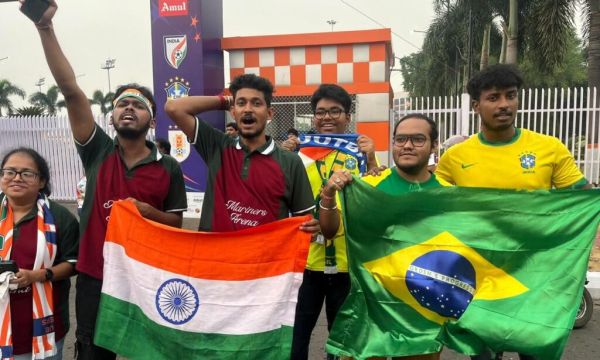
Ajay Manda, a Brazil fan from Baruipur in South 24 Parganas, said while waiting outside the stadium that, as an Indian, he would support India but also wanted to see Brazil’s “Samba magic.” “But how would an India win be possible in the face of the Brazilian magic that we have come to see?” he wondered. He then offered a simple solution. “If India play well and at least score one goal without conceding many, that will do,” he said.
That dilemma is even more pronounced for a Brazilian who has made Kolkata his home. Edvan Carvalho, who has lived in the city for 20 years, said his family would support both teams “50-50”. “Brazil is my country, but I have become one with this country, its people and its football,” he said.



Yuzvendra Chahal retired from first class cricket
Why Hardik is very important for India in 2027 World Cup, Ganguly told
Ex-India star predicts Ajit Agarkar’s regret as Rohit Sharma silences doubters
'Agarkar Will Now Be Regretting': Rohit Sharma's Century Draws Big Remark From Ex-India Cricketer