

Shivam Sharma
abplive|03-10-2026
The International Cricket Council has introduced a series of changes to the playing conditions for both men's and women's international cricket. The updated regulations are aimed at bringing greater consistency across formats, speeding up the game and removing confusion around certain situations.
The revised rules apply from October 1, although bilateral series that were already underway before that date will continue under the previous playing conditions.
Among the most notable changes is a stricter approach to time-wasting, with repeated violations potentially resulting in five penalty runs.
ICC has also clarified the rules surrounding overthrows, catches, stumpings and run-outs. Meanwhile, the use of a pink ball in daytime Test matches will be trialled as a possible solution to poor-light interruptions.Here are the 10 major rule changes explained:
Batters will now be required to be ready to face the next delivery within the prescribed time limit. However, teams will not immediately be penalised for a first offence.
The first violation will result in a warning, while a second offence will bring a final warning. If the same batter or team commits a third violation, the opposition will receive five penalty runs.
Every subsequent breach will result in another five penalty runs being awarded to the other team.The measure is intended to reduce unnecessary delays and help matches finish within the scheduled timeframe.
ICC has also specified the permissible dimensions of the ball used in women's international cricket. The ball must weigh between 142 and 149 grams, while its circumference must fall between 21.5 and 22 centimetres.
ICC has provided greater clarity on what constitutes an overthrow.
An overthrow will refer specifically to a fielder throwing the ball towards the stumps while attempting to prevent runs or effect a run-out.
A simple misfield will not be treated as an overthrow, irrespective of whether the fielder is trying to stop the ball or pass it to another teammate.
The ball will not necessarily have to be in the hands of the bowler or wicketkeeper for it to be considered dead.
Under the revised provision, umpires will have greater discretion to determine whether the ball has become completely stationary and should therefore be declared dead.
The revised rules also clarify the requirement for ball control during stumpings and run-outs.
A fielder must have complete control of the ball when attempting to put down the stumps. If the ball only brushes the fielder before making contact with the stumps, it will not be considered to have been under the fielder's control.
One of the most significant changes involves the use of the pink ball.
Teams will be allowed to use a pink ball in daytime Test matches on a trial basis. The idea is to provide an alternative in conditions where poor light could otherwise lead to a premature end to the day's play.
However, both teams must agree to use the pink ball.
A wicket falling during the final over of a day's play will no longer automatically bring the day's action to an end.
The remaining deliveries of that over will now be completed, allowing the scheduled over to be finished.
The ICC has standardised the innings interval in T20 Internationals at 15 minutes.
If playing time has been lost during the match, the break can be shortened to 10 minutes to help teams recover some of the lost time.
A new provision allows the head coach, or a designated representative, to enter the playing area during scheduled drinks breaks in ODIs and T20Is.
This provides coaching staff with an opportunity to communicate directly with players during the designated break.
The revised wide-ball provision, which had previously been introduced on a trial basis, has now been incorporated permanently into the playing conditions for ODIs and T20Is.
The decision on whether a delivery is wide will be based on the batter's position at the moment the ball is delivered. This will apply even if the batter subsequently moves towards the off side.



ILT20 auction: Fazalhaq Farooqi, Liam Livingstone lead top 10 buys as four players cross USD 300,000

ILT20 Season 5 auction: Full squad lists and spending of all six franchises

BCCI president Mithun Manhas acknowledges need for better infrastructure in J&K districts
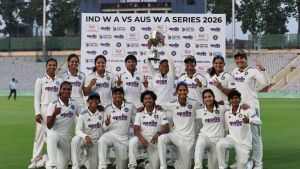
IND-A vs AUS A Unofficial Test Day 3: India registers mammoth 281-run win over Australia