The finest batters possess a quality that cannot quite be reduced to technique. Technique may explain the straightness of the drive, the stillness of the head and the balance at the moment of impact. It does not explain why the whole thing should seem beautiful.
Shubman Gill has that beauty. Yet beauty, by itself, is not enough. Sport is not choreography. Beauty matters because something is at stake. On Wednesday, it was 406.
There is a particular responsibility in a large chase. Someone has to stay long enough for the number to become ordinary. Gill understands that responsibility and seems to embrace it. Like Virat Kohli, he appears to relish the challenge of being the set batter who carries an innings through.
Last year in England, after India lost the first Test at Leeds despite his first-innings 147, Gill responded in the next Test by batting for 549 balls and scoring 430 runs across the match.
Here, with the series at stake, he assumed that responsibility again. He turned the chase of 406 into an exhibition of how compact and expansive can coexist, how violence can be contained within grace.
His wrists worked with extraordinary delicacy. He cut late, flicked behind square and punched through cover. He drove full-faced and straight. When Alzarri Joseph sent down a short ball at serious pace, Gill answered with his compact short-arm jab. He used his feet repeatedly, dancing down to Roston Chase and Keemo Paul, getting to the pitch of the ball and sending it over square leg and towards cow corner.
Gill had no elaborate strategy, just a succession of modest propositions: 75-80 in the PowerPlay, no wickets; 200-210 by 25 overs; survive the new ball; exploit the older ball; remember the short side. Yet that is how a big chase becomes psychologically possible. India made 92 without loss in the first 10 overs and then exceeded Gill’s next checkpoint, too.
He had already spent 50 overs in the field when he began. He then batted through all 43.3 overs of the chase. There was skill, certainly, but also discipline, appetite and fitness. The innings had the rare quality of seeming effortless while demanding everything.
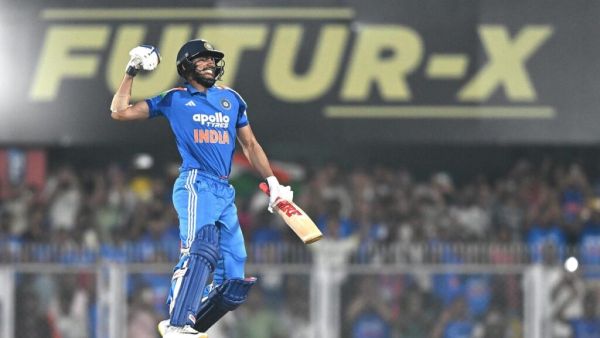
The numbers were spectacular: an unbeaten 223 from 133 balls, his second ODI double-century and India’s highest successful chase. But numbers can flatten the texture of an innings. They cannot quite describe the impression of a batter who seems to have discovered that the shortest distance between himself and greatness is simply to keep batting.