

Samira Vishwas
Tezzbuzz|22-09-2026
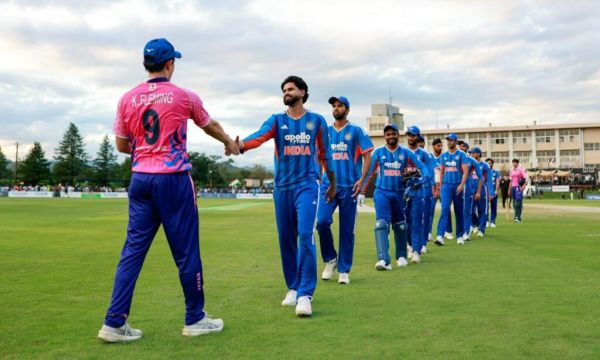
World champions India survived a scare to win by just two runs in a thriller against Japan in the rain-hit historic one-off T20I in Sano on Tuesday (September 22).
India, who are the top-ranked side in ICC T20I standings, edged the 41st-ranked Japan in a five-overs-per-side contest. This was the first-ever T20I between the sides.
India score 32/4
Due to rain, the match was shortened at the Sano International Cricket Ground, and the underlying moisture on the surface offered more than expected turn, the apparent gulf in talent and experience was seemingly bridged as India managed only 32 for 4 in five overs, hitting a total of three boundaries.
Japan were kept to 30/3 in five overs.While defending the target, India looked in danger of being embarrassed when Ravi Bishnoi went for 10 runs in the third over and Washington Sundar (2/13) gave away seven in the penultimate over.
Also read: Asian Games 2026: Women’s cricket team gives India first gold
However, with eight runs required off the final over, Axar Patel’s (2-0-7-0) experience of playing 150-plus IPL games came in handy as he didn’t give any room to Shirai Patmore and Benjamin Ito-Davis to chance their arms.
It also helped that rain had slowed down the outfield.
Contentious wide calls
In the final over, umpire Chris Thurgate gave a few contentious wide calls when left-handed Patmore tried playing the reverse slog and missed twice.
An unhappy Indian skipper Shreyas Iyer complained to leg-umpire Chris Brown and the second wide was overturned.
While Japan gave India a scare but it had more to do with the shortened game on a rank turner that literally made the match into a lottery.
Also, unlike the track in Aichi-Nagoya where the women’s team won gold medal with a power-packed batting show, the Sano pitch didn’t offer conducive conditions which one associates with strokeplay in T20 cricket.
Abhishek bags golden duck
Earlier, unheralded Japanese spinners challenged the star-studded Indian batting line-up to restrict them to a below-par 32 for 4, which might have made skipper Shreyas Iyer question his decision to bat first.
The underlying moisture of the pitch helped in providing appreciable turn for left-arm spinner Charlie Hara Hinze (2/17) and off-spinner Ibrahim Takahashi (1/13).
Abhishek Sharma was dismissed for a golden duck by Hara-Hinze after the Indian swashbuckler mis-timed a slog sweep while Takahashi flighted one to deceive Sanju Samson (10) in the air with his heave being taken at mid-wicket boundary.
Benjamin Ito-Davis (1/2) then got rid of Ishan Kishan (3), who was consistently trying to hit against the turn and ended up ballooning one to mid-off.
Shreyas Iyer (16) hit a boundary but the pitch was such that Indian players found it difficult to hit across the line.
Vande Mataram played before match
The turn and the slowness of the track contributed to their downfall and the shorter duration of the match meant that there was no chance of a recovery.
Credit must be given to the three Japanese spinners and skipper Kendel Kadowaki-Fleming who understood the conditions at the venue where the home team plays all its home games.
Earlier, Vande Mataram was played before the match for the first time on foreign soil when the national song preceded the national anthem before the start of play.
Vande Mataram was first played ahead of the Indian national anthem before the start of play in India’s first T20I against Afghanistan on September 13, marking the first such instance in any international sports event.
The Ministry of Home Affairs had issued guidelines on February 6 this year requiring the rendition of Vande Mataram as part of the 150th anniversary of the national song.
(With agency inputs)





Historic India vs Japan T20I under a dark cloud as Typhoon soaks Sano Ground

India T20I Selection: 3 Players Who Could Face Pressure After Afghanistan Series

India's Japan Cricket Visit: How a Small City Is Preparing for a Historic Showdown

Chennai Super Kings ropes in Zaheer Khan as Head Coach for IPL 2027