

Prateek Thakur
abplive|22-09-2026
Good to see Vande Mataram before the India–Japan Suzuki cricket match. 🇮🇳🏏@JaipurDialogues @dtbyaadi pic.twitter.com/I5LFlDOVfx
— Ankur Chaudhary 🇮🇳🇯🇵 (@ankurJapan) September 22, 2026
The Union Home Ministry’s 2026 guidelines specify that when the National Song and National Anthem are performed together, the National Song should come first.
The MHA issued fresh directions in July 2026 covering the correct text, diction, pronunciation and sequence for the National Song and National Anthem during designated official functions.
The protocol states that “Vande Mataram” should be followed by “Jana Gana Mana” when both are included in the same programme, explaining the sequence witnessed in Sano.
Why Was Vande Mataram Played First?
The order of presentation does not mean that “Vande Mataram” has replaced the National Anthem or that “Jana Gana Mana” has changed its official status.
Instead, the two songs have separate designations, with “Vande Mataram” serving as the National Song and “Jana Gana Mana” remaining the National Anthem.
The 2026 government guidance specifically lays down the sequence for occasions where both are sung or played, requiring the National Song to precede the National Anthem.
The guidelines also prescribe the official version of “Vande Mataram”, including all six stanzas, with the complete rendition taking approximately three minutes and 10 seconds.
India-Japan T20I Creates History In Sano
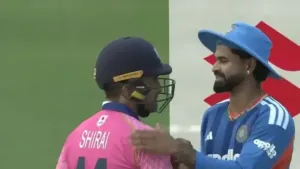
The ceremony preceded a landmark men's T20I between India and Japan at the Sano International Cricket Ground, with the fixture marking their first-ever men's international meeting.
The match forms part of events marking 75 years of diplomatic relations between India and Japan, bringing the two countries together through a significant cricketing occasion.
India captain Shreyas Iyer won the toss and chose to bat first after severe delays caused by a wet outfield reduced the contest to five overs per side.
India also made changes to their combination for the shortened match, with Jasprit Bumrah rested and Yash Thakur joining Arshdeep Singh in the bowling attack.
Sanju Samson and Abhishek Sharma continued as India's opening pair, while young batter Vaibhav Sooryavanshi remained among the substitutes for the historic fixture.
The unusual five-over format added another layer to an already significant occasion, with the pre-match ceremony drawing attention before the action began.
MHA Guidelines Behind The Ceremony
The Home Ministry's updated protocol came as India marked 150 years of “Vande Mataram”, with the government issuing detailed directions concerning its rendition and its sequence alongside the National Anthem.
The guidelines state that when both songs are performed together, “Vande Mataram” should be played or sung first, followed by “Jana Gana Mana”.
The sequence seen before the India-Japan match therefore reflected an existing government protocol rather than an alteration to the country's National Anthem arrangements.
The moment nevertheless stood out because such ceremonial details are rarely seen in an international cricket setting, particularly during India's first men's T20I against Japan.
A Landmark Night For India And Japan
While the songs provided an unexpected talking point before the match, the fixture itself carried considerable significance for cricket's development between India and Japan.
The one-off T20I was staged as part of wider India-Japan sporting engagement, with both teams entering the contest in a match that created cricketing history.
For India, the game also formed part of preparations around the Asian Games, while Japan gained the opportunity to face one of international cricket's leading teams.
The combination of a historic opponent, a rain-affected five-over contest and an unusual pre-match ceremony made the Sano fixture unlike a routine international cricket evening.


CSK coach changed after 18 years, explosive entry of Zaheer Khan in place of Stephen Fleming
“We need match-winners”: Former pacer backs two Kohinoors of Indian cricket for 2027 ODI World Cup
CSK names Zaheer Khan as new head coach for IPL 2027
Chennai Super Kings Announce Zaheer Khan As New Head Coach