Samira Vishwas
Tezzbuzz|16-09-2026
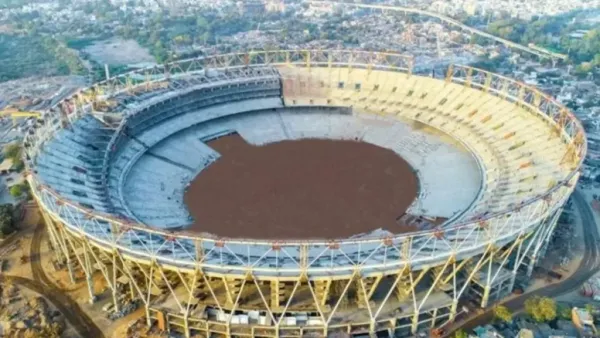
Delhi: According to a record, at present there are 30 stadiums in India which are claimed to host international cricket there. Their biggest complaint? That means matches are not organised. Even big stadiums like Kolkata's Eden Gardens and Mumbai's Wankhede have the same complaint. At present, 28 new stadiums of modern and international standard are being built in different cities of India.
The already existing stadiums are not getting matches, so how can we expect that all these new stadiums will get to host international matches? Will hosting a few matches of domestic trophies, as it is unrealistic to expect every stadium to host IPL matches, justify the expense of building these big stadiums?
Big stadiums have been built, now who will bear the maintenance expenses?
The biggest issue is the maintenance cost of new and huge stadiums. The question arises that when there is no domestic cricket season then why are these stadiums not used for other sports?
From here, apart from the stadiums of India, it becomes necessary to talk about Australia's largest cricket stadium, MCG i.e. Melbourne Cricket Ground.
The game at MCG changes as soon as cricket ends
The last Test at MCG was played in December 2025. After this, when the weather conditions were suitable for outdoor games, football league matches were played in this huge cricket stadium.
The most interesting thing is that the ground of this stadium, famous for cricket, is circular, but for football, a rectangular field can be easily prepared here. That means the stadium is not limited to just cricket.
One stadium, many games and use all year round
Australia has understood the proper use of stadiums better than most sports loving countries. The big cricket grounds there keep changing their identity according to the weather.
When the cricket season ends, Australian Rules Football starts. When football ends, cricket returns. Meanwhile, the ground is also available for soccer, rugby, concerts and other big events.
Not just cricket, dozens of matches every year in MCG
Melbourne Cricket Ground is the best example of this. The four AFL clubs play most of their home matches there. The stadium hosts at least 45 AFL home-and-away matches each year, including finals.
At the same time, Cricket Australia and Cricket Victoria use MCG for cricket for about 30 days every summer. Despite this arrangement, the stadium continues to be used for other sports and major events, provided the calendar allows it.
Doesn't football spoil the cricket pitch?
When a cricket ground is used for football or any other outdoor game, the first question that arises is about the pitch. But Australia has found a way out of this too.
In most stadiums there, portable or 'drop-in' cricket pitches are used instead of traditional turf pitches. It can be installed and removed from the field as per the need. This significantly reduces the impact of damage caused to the cricket pitch due to other sports.
Why can't India also adopt Australia's model?
From here the biggest question arises for India. Why can't some of the biggest cricket stadiums in India also be made multi-sport venues in a similar manner?
There is a formal policy for this in Australia. While giving land for the stadium, the government decides the way of its use. That is, after the stadium is built, it is not thought about how it will be used, rather its planning is done even before construction.
Which game's turn is decided before the season
The Australian model is not an informal arrangement in which when one sport's season ends, another takes over the field. In Victoria, where the MCG is located, there is a formal agreement between Cricket Victoria and AFL Victoria for the use of the stadium.
Under this, football gets priority from 1 April to 30 September, while cricket is given priority from 1 October to 31 March.
This is the most important thing about this model. The method of sharing ground works only when the complete calendar and arrangements are decided before the start of the season.
Problem of stadium remaining empty in India
In contrast, in India, most of the thinking about the use of stadiums is done keeping in mind the cricket calendar. There is an international match or a big event, but after that the use of the stadium reduces considerably until the next match.
You may be surprised to know that at one time hockey matches were also played at Wankhede Stadium. But due to there being no concrete policy regarding the use of the stadium, this process could not move forward.
MCG showed how quickly grounds can be changed
MCG can be ready for different sports in a very short time. Thanks to its portable pitch system, the stadium was able to prepare a FIFA standard soccer pitch for the 2000 Olympics just 10 days after the AFL Grand Final.
This is not just a story of technology. This is a story of thinking beyond one sport while building a cricket stadium.
Australia's model is slowly growing
This model is now slowly reaching other stadiums also. A similar arrangement has been adopted at another major sports venue in Victoria, Geelong's Cardinia Park.
A stronger hybrid turf surface has been installed here, which has been designed to provide more flexibility. AFL, AFLW, VFL, cricket, football and community events take place in this stadium.
After the football season ends, cricket returns in the summer. That means the same ground is used for different sports and events throughout the year.
New and expensive stadiums are continuously being built in India. In such a situation, it may be difficult to meet their expenses just by relying on international cricket matches. Perhaps now the time has come that the stadium should not be seen just as a cricket ground, but as a sports venue that can be used throughout the year.




Sunil Gavaskar pushes BCCI to lean on Sachin Tendulkar, Sourav Ganguly and Rahul Dravid

Mukesh Kumar joins County side Nottinghamshire for last two rounds

Aakash Chopra raises question over Sanju Samson after 1st T20I against Afghanistan

Here are three replacements for Varun Chakaravarthy if the spinner is ruled out of Asian Games 2026